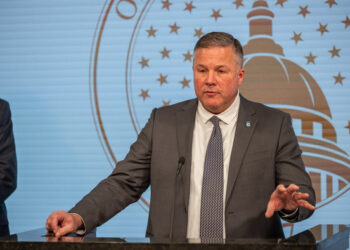






OKLAHOMA CITY (OBV) — “With taxes and tariffs, the remitter of the tax is seldom the party who bears the economic burden,” economist Dr. Russell Evans told OBV.
If importers ultimately receive refunds of duties now deemed unlawful, he added, “it will likely be a small windfall for the importer who will receive the full value of the refund and having borne only a piece of the true economic burden.”
His point frames the local story.
Even after a 6–3 Supreme Court decision struck down President Donald Trump’s sweeping emergency‑based tariffs on Friday, the near‑term impact for most Oklahoma firms looks muted and uneven—more about accounting, contracts and lead times than headline shocks.
What happened—and why it’s not a clean reset
The Court held that the International Emergency Economic Powers Act (IEEPA) doesn’t authorize the president to impose tariffs, a power Congress typically delegates explicitly.
Within hours, the White House pivoted to a different playbook, installing a 10% global duty under Section 122 of the Trade Act of 1974, then pushing it to 15% on Saturday which is the statutory ceiling for a maximum of 150 days.
That temporary surcharge starts Feb. 24 and exempts certain categories and USMCA‑compliant goods. In parallel, pre‑existing tariffs tied to national security (Section 232) and unfair practices (Section 301) remain in force.
For Oklahoma companies, that means the “big” legal ruling doesn’t automatically drop effective rates to zero.
Instead, it swaps one authority for another and puts it on a timer.
“By design, tariff revenue is a temporary tax stream,” Evans said. “Tariffs can be useful tools to ensure compliance with trade agreements or to protect intellectual property, they cannot be sustainable major long-run sources of federal revenue.”
The 150‑day clock under Section 122 underscores that point.
Refunds: a legal maze, not a windfall for everyone
The justices left the refund question to lower courts.
Estimates vary, however, analyses cited by Reuters and CNBC put potential exposure up to $175 billion, while other reporting highlights about $133 billion collected that could be contested.
Trade lawyers expect a protracted process through U.S. Customs and the Court of International Trade and any cash back would arrive months from now and may not match each company’s true economic burden—especially for firms that passed costs forward to customers or backward to suppliers.
Evans cautions against assuming refunds equal relief: pass‑through dynamics during the tariff period will determine who actually benefited or suffered.
In practice, the importer who files the claim could recoup more than the cost they truly absorbed—“a small windfall”—while counterparties and consumers who bore part of the burden don’t get reimbursed. That asymmetry complicates pricing decisions in the meantime.
Policy in motion: new 301 cases on deck
The administration says it will open new Section 301 investigations across “most major trading partners,” covering topics from industrial overcapacity and digital‑services taxes to drug pricing and labor practices.
Those cases require procedure and time, but they can culminate in targeted duties that outlast Section 122’s 150‑day window. New Section 301 investigations would extend policy pressure beyond the 150‑day window if they result in targeted duties.
Evans notes that if the White House cannot secure the same effect through tariffs, “there would certainly be some creative fee and license structures that could mimic the effect and revenue of tariffs without actually being called tariffs and find its way through the court system again.”
Taken together, the moves point to continued policy movement rather than a return to pre‑2025 conditions.
So what changes on the ground in Oklahoma?
- Retailers and distributors that paid IEEPA‑based duties could see modest margin relief if their products are outside the remaining 232/301 buckets and if suppliers don’t claw back price cuts. The new 15% surcharge offsets part of that relief until late July unless replaced.
- Construction and manufacturers still face Section 232 metals duties and project‑cost pressures. Some exemptions exist, but the broad structure stays in place while the temporary global tariff overlays it.
- Exporters gain little immediate clarity. The ruling could reduce some diplomatic friction, but partners are watching the 15% stop‑gap and any 301 actions before adjusting their own measures.
- Cash‑flow planners should document tariff payments and supply‑chain pass‑throughs now to support possible refund claims later—and to negotiate supplier/customer adjustments as rates whipsaw. (Courts and Customs will shape timelines and the process is widely expected to be slow.)
Why prices may not fall much (or evenly)
Even if some line items shed the IEEPA tariff, the 15% global overlay keeps a floor under landed costs for the next five months, and many goods remain under existing 232/301 regimes.
Meanwhile, distributors with inventory bought at higher tariff rates may work down stock before changing price lists.
That’s why Evans emphasizes modest near‑term effects.
“Perhaps some very modest downward pressure on prices,” he said, with the caveat that experiences will vary by industry and how each firm “perceived the previous impacts of the tariff regime.”
Market signals vs. business planning
Markets nudged higher after the ruling, then cooled as the White House announced a temporary global tariff and potential 301 cases.
For Oklahoma businesses the bigger issue is timing. Section 122 is on a 150‑day clock. Section 301 is procedural and slower. Both leave space for negotiation, carveouts and litigation. That context affects how firms manage pricing and inventory, including contract terms that allow tariff‑linked adjustments and a live list of items by SKU and HTS code with current duty rates.
Bottom line for Oklahoma
As of this week, the Court clipped one of the broadest tariff tools—but the administration maxed out a temporary replacement and is preparing longer‑run cases. For most Oklahoma businesses, that translates to “not much—yet” in day‑to‑day operations, with modest price tailwinds at best, and continued policy noise through mid‑summer.