Faces of Free Enterprise returns with higher education conversation
State Regents Chancellor Sean Burrage joined State Chamber Board Chair Rick Nagel to discuss capitalism, workforce and the role of higher education in Oklahoma’s economy.
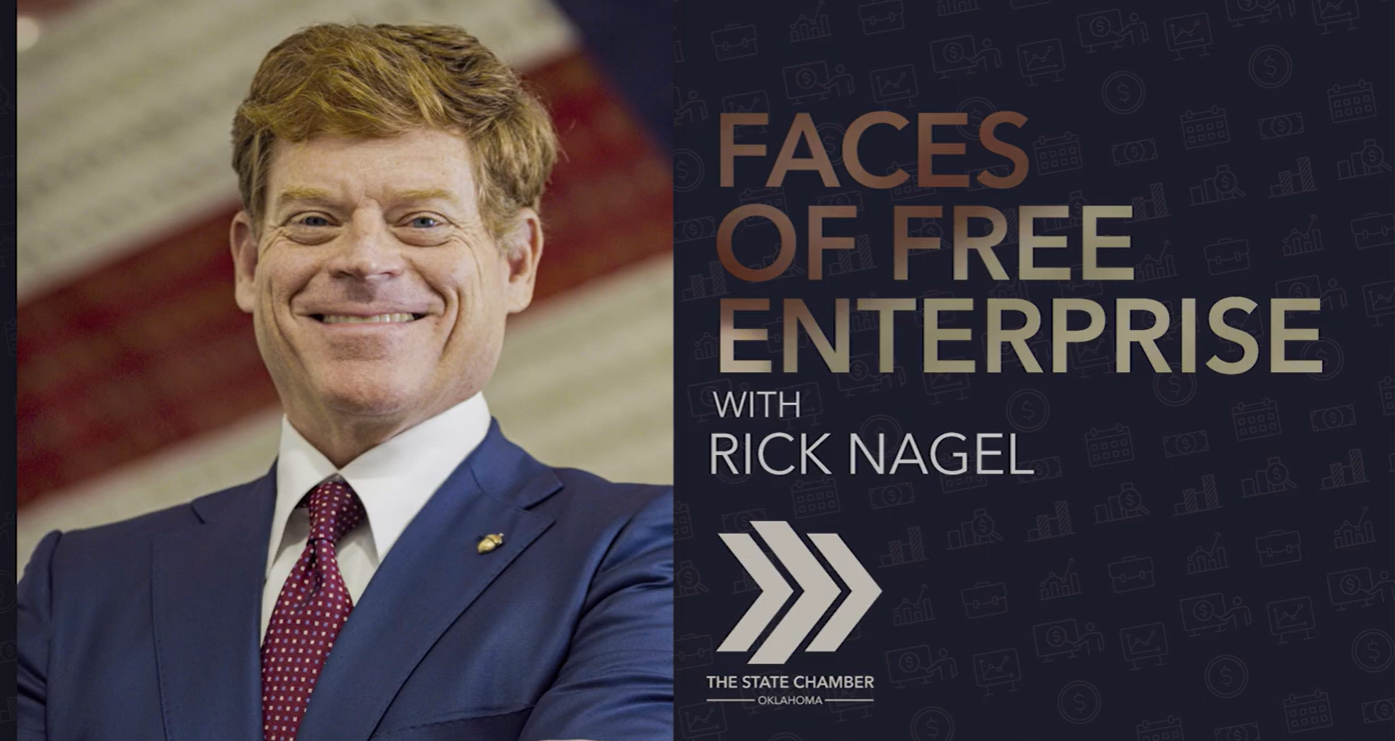
OKLAHOMA CITY (OBV) — The State Chamber of Oklahoma’s Faces of Free Enterprise series has returned with a new episode focused on the connection between higher education, workforce development and Oklahoma’s economic future.
The latest episode features Oklahoma State Regents for Higher Education Chancellor Sean Burrage in conversation with State Chamber Board Chair Rick Nagel. The discussion explores how the free enterprise system and higher education can work together to strengthen Oklahoma’s workforce, attract business investment and expand opportunity across the state.
Nagel opened the episode by framing the series as a way to highlight the role capitalism and free enterprise play in everyday life.
“This series was created by the State Chamber as a way for us to tell the stories of where capitalism and free enterprise are working for all of us every single day,” Nagel said. “It’s obviously the cornerstone and bedrock of our country.”
Burrage brought a wide-ranging perspective to the conversation. A former state senator, former president of Southeastern Oklahoma State University and former chief of staff at the University of Oklahoma, Burrage said higher education has a direct role in Oklahoma’s ability to compete for jobs and investment.
Burrage said his work with the MidAmerica Industrial Park has shown him what companies look for when deciding whether to invest in Oklahoma.
“They’re looking for a reasonable place to do business,” Burrage said. “The land costs here are reasonable. Our utility costs are reasonable. We have, compared to other states, we’ve got water.”
But Burrage said the state still faces a major challenge in workforce readiness.
“Where I’m told we’re usually missing is on having a healthy and educated workforce,” Burrage said. “And that’s where higher education comes in.”
Burrage said Oklahoma trails the national average in bachelor’s degree attainment. About 28% of Oklahomans have a bachelor’s degree or higher, compared with a national average of 37%, he said.
“So what I say is, in a political campaign, that’s a landslide and we just lost,” Burrage said.
The conversation also touched on the value of a college degree and the need to better communicate that value to students and families. Burrage said college remains one of the clearest ways to change a family’s economic trajectory.
“If they do, we know they make $20,000 a year more the rest of their life,” Burrage said. “That’s a pretty good case that the data tells us.”
Burrage said his time at Southeastern showed him how higher education can transform families across generations, particularly for first-generation college students.
“When I would see those people walk across stage, we weren’t just changing their lives,” Burrage said. “We were changing the trajectory of their children’s lives and their grandchildren’s lives.”
Nagel and Burrage also discussed the State Chamber’s focus on literacy and math as foundational workforce issues. Burrage said Oklahoma is at an important moment for education reform, citing leadership from Gov. Kevin Stitt, legislative leaders, the State Chamber and university presidents.
“We have work to do,” Burrage said. “The leadership we’re seeing from the governor, from Speaker Hilbert, from Pro Tem Paxton, from the State Chamber, Chad Warmington, yourself — we’ve not seen everybody come together like this before.”
Burrage said higher education must also continue becoming more responsive to lawmakers, employers and workforce needs. He acknowledged that some criticism of higher education has been earned.
“I think a lot of the rumors about higher education are well-deserved,” Burrage said. “We spent a lot of years not paying attention and not being responsive.”
He said the system has begun making changes, including eliminating low-producing programs that are not tied to workforce needs.
“This last year, we eliminated 60 programs in the state of Oklahoma, low-producing programs that weren’t workforce-related,” Burrage said. “My guess is we’ll probably do another 30 to 50 this year.”
For Burrage, the mission is clear.
“I believe that higher education’s key job is to drive the economy,” Burrage said. “You can have football teams. You can have performances. You can learn the classics. But really and truly, we’re here to drive the economy.”
The episode also addresses young people’s declining confidence in capitalism. Burrage defended free enterprise as central to American prosperity.
“Capitalism has worked and it is working,” Burrage said. “We live in the richest nation. We have the best lifestyle in the history of the world. And it’s all because of the free enterprise system.”
Nagel and Burrage closed by discussing how businesses and universities can work more closely together. Burrage said employers should engage students earlier through internships and apprenticeships instead of waiting until graduation.
“If you got to them a little earlier and gave them real, meaningful internships and apprenticeships, you would find talent,” Burrage said. “Both sides would have an opportunity to learn more about each other.”
The full episode is available here.