Sky’s the Limit: AAR Opens Hangar 4 at Will Rogers as Oklahoma Aerospace Momentum Builds
New hangar fuels aerospace growth.
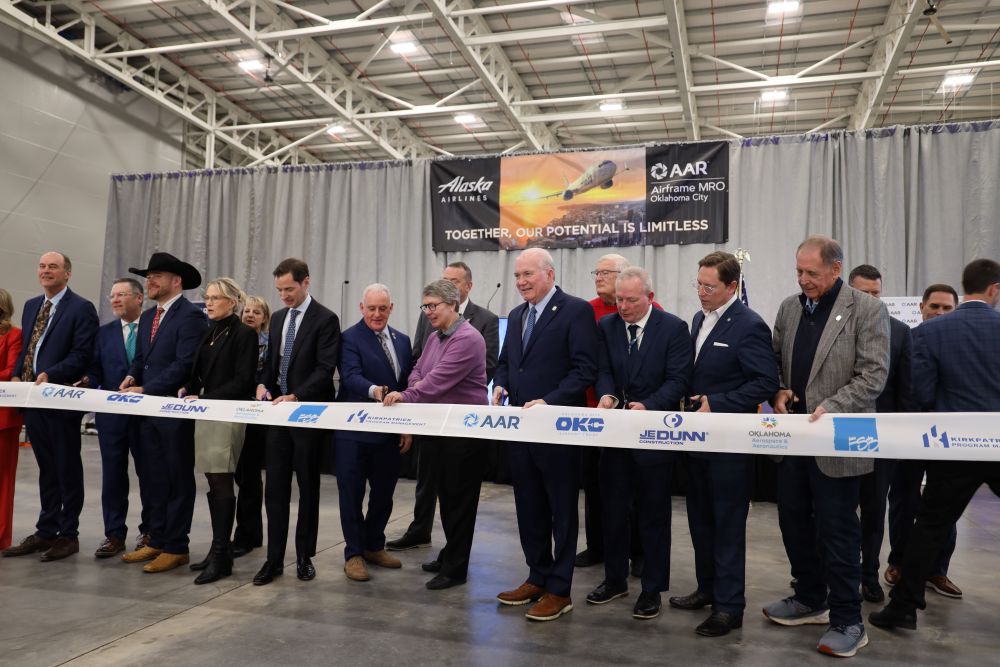
AAR Aircraft Services cut the ribbon on its new Hangar 4 facility at Oklahoma City’s Will Rogers International Airport, marking the latest investment in a sector state leaders say is accelerating fast—and has the runway to grow even faster.
The event brought together airport officials, state lawmakers, AAR leadership, construction partners, and Alaska Airlines, a longtime AAR customer whose fleet needs helped shape the project’s next-gen capacity.
Speaking at the ceremony, Grayson Ardies, executive director of the Oklahoma Department of Aerospace and Aeronautics, framed the project as a visible marker of momentum. Oklahoma’s aerospace and defense sector now represents a $19.1 billion industry statewide, supported by five military bases and a growing civilian aviation ecosystem.
“This is obviously one project—an 80,000-square-foot hangar—but we have more than 175 hangar units built over the last five years,” Ardies said. “That’s over 600,000 square feet of new hangar space statewide, and this facility alone represents more than 10 percent of that total.”
For state leaders, Hangar 4 also reflects a deliberate strategy: invest in infrastructure that keeps skilled workers, attracts global operators, and positions Oklahoma competitively as air travel and fleet maintenance demand accelerates. Representative Emily Gise, whose district includes Will Rogers International Airport, emphasized the broader economic role airports play.
“Oklahoma’s airports are more than runways and hangars—they’re economic engines,” she said. “We have 108 public airports generating more than $10.6 billion in economic impact each year, and nearly 40 percent of our aerospace companies are located directly on an airport.”
AAR President and CEO John Holmes, whose career with the company began at the Oklahoma City facility nearly 25 years ago, described the project as both professional and personal. He said the expansion hinged on three conditions: a skilled workforce, long-term customer commitment, and a supportive business environment.
“All three of those things turned out to be true here in Oklahoma,” Holmes said.
Holmes offered a moment that drew knowing laughter from the crowd—and captured why the project moved quickly.
“A lot of times, government can be in the way of business,” he said. “It can slow things down. But here, this experience was the opposite. In my 25 years, I’ve never seen anything like it. We were actually being pushed. It was, ‘You’ve got the funding. We’ve got the contract. What do you need?’ I wish it worked like that everywhere.”
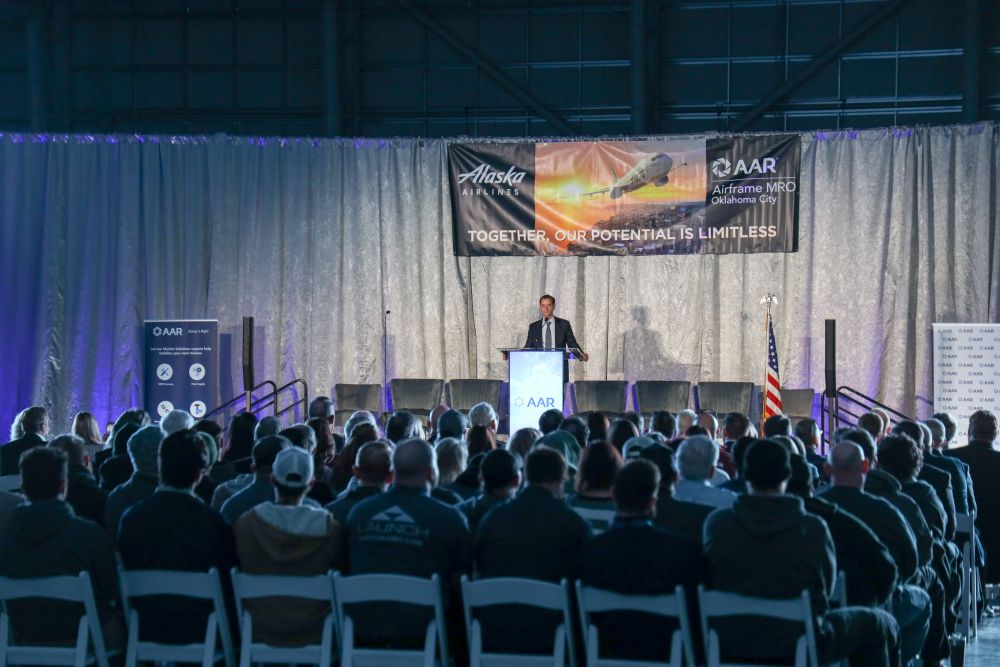
A lot of times, government can be in the way of business. It can slow things down. But here, this experience was the opposite. In my 25 years, I’ve never seen anything like it. We were actually being pushed. It was, ‘You’ve got the funding. We’ve got the contract. What do you need?’ I wish it worked like that everywhere.
– John Holmes, Chairman, President and CEO, AAR
That collaboration is already translating into jobs. Holmes confirmed the new hangar will support approximately 200 new positions, tied to next-generation aircraft maintenance and long-term workforce development. Alaska Airlines, AAR’s longest-standing MRO customer, committed aircraft to the facility, citing quality standards and the depth of the Oklahoma-based team.
That sense of momentum was echoed by state leaders, who framed the hangar not as a finish line, but as part of a longer buildout for the state’s aviation sector. Senate Appropriations Chair Chuck Hall pointed to sustained investment as the difference between short-term wins and long-term competitiveness.
“We’re making these investments because aerospace is not a moment for Oklahoma—it’s a future,” Hall said. “If we want to continue attracting companies like AAR, and if we want our workforce to have opportunity here at home, we have to keep building capacity and infrastructure that allows this industry to grow.”