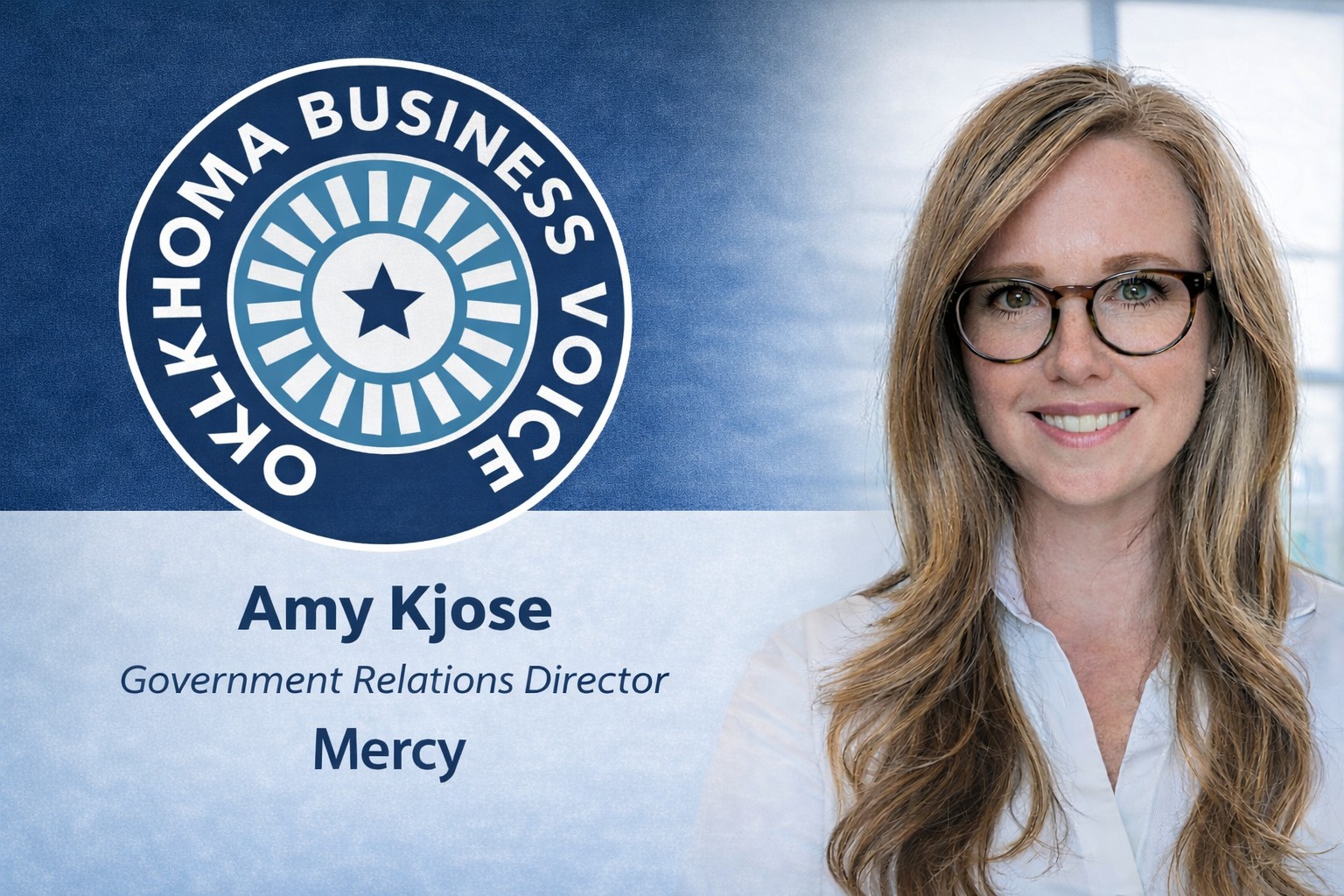
Committee spotlight: Amy Kjose on calibrating Oklahoma’s liability climate
The State Chamber’s Legal and Labor Reform Committee chair says predictable rules and fair process help businesses grow while keeping bad actors in check.
The State Chamber has policy committees for key areas of Oklahoma’s business climate, and the Legal and Labor Reform Committee ensures employers have a fair, predictable regulatory environment. The committee evaluates legislation affecting liability exposure, employment law, workers’ compensation, litigation reforms, and the overall legal framework businesses must navigate. This spotlight highlights the chair who leads this work and helps guide member input on policies that protect competitiveness and reduce unnecessary litigation risks.
OKLAHOMA CITY (OBV) — As government relations director for Mercy in Oklahoma, Amy Kjose works with physicians, administrators and caregivers to help the health system serve patients across both rural and urban communities.
“I get to work with all our fantastic physicians and administrators and providers figuring out how to make the health care system in Oklahoma work best for Oklahomans so we can provide the best care possible,” she said.
Kjose chairs The State Chamber’s Legal and Labor Reform Committee, which tackles legal reform and labor issues affecting employers statewide, and credits the Chamber’s staff—“Adam Maxey [is] handling the forefront of those efforts at the state Capitol”—for day-to-day advocacy as the committee sets strategy and priorities.
Her path to the role started in Washington, D.C., where she spent five years working with state lawmakers on tort and workers’ compensation reform, developing model policy adopted across the states. After moving to Oklahoma 15 years ago, she broadened her portfolio beyond torts to health care, criminal justice and economic development.
The committee is coming off “a year of some great success,” Kjose said, pointing to newly enacted tort measures such as reasonable caps on noneconomic damages and other reforms designed to improve the state’s liability environment—a top concern in last year’s business surveys.
“In total [these changes] will improve the liability climate for businesses,” she said.
Looking ahead, members are focused on three pressure points that drive up costs and uncertainty: the recruitment of lawsuits, the funding behind them, and the civil process that determines how cases move through the courts.
Oklahoma now requires disclosure when third parties fund lawsuits—reforms passed last year—while the committee works on additional steps to keep the system “fair” and “predictable.”
Kjose traces her approach to a mentor, the late Victor Schwartz, whose “dial” analogy guides her thinking on liability. Turn the dial too high, and the system catches everything; turn it too low, and it catches nothing.
The goal is calibration—“exactly the right level”—to deter wrongdoing without penalizing responsible employers who are delivering goods and services.
Her advice to early career professionals is simple: take initiative. career professionals is simple: take initiative.
“Ask questions, get interested in the subject, and learn as much as you possibly can,” she said. “I’m a bit of a nerd, but I would spend extra time poring over case law, looking at statutes and brainstorming.”