The cardinal and the credential
Rep. Brian Hill’s workforce bill aims to connect education and earnings with a transparent, statewide list built on data, demand and real-world outcomes.
OKLAHOMA CITY (OBV) — Cardinals don’t migrate.
They stay put. Bright red in the dead of winter, stubbornly local, built for the long haul.
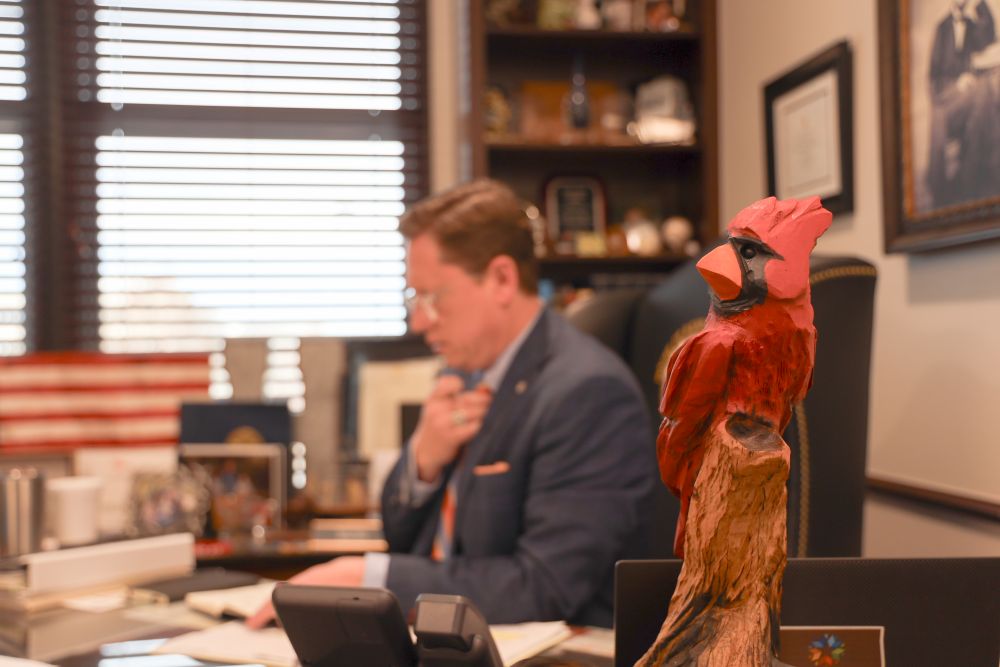
It’s a fitting symbol to find perched on the corner of a legislator’s desk.
The cardinal in Rep. Brian Hill’s Capitol office isn’t alive, of course. It’s carved wood. Made by a student in Hill’s district, painted in that unmistakable red, and placed where it can be seen in nearly every conversation Hill has about the future.
On this day, Hill talks about something rooted in outcomes, not ornament: how Oklahoma helps students make education decisions with fewer blind spots and fewer expensive surprises.
That’s the premise of House Bill 2398, which would create a statewide framework for identifying and publishing “credentials of value”—degrees, certificates, licenses, and other credentials that show a measurable payoff and match workforce needs.
As of Feb. 17, 2026, the bill had received a “do pass” recommendation in the House process, advanced with a committee substitute and continued through the education policy pipeline.
A workforce conversation that goes beyond one agency
Hill frames HB 2398 as the product of a broader shift in how Oklahoma thinks about workforce. Less as a single program and more as a connected system.
“Several years ago, we began a conversation about what workforce looked like,” said Hill. “I remember talking about coming out of COVID, the idea of workforce gap, and where the need was compared to what was being produced by higher ed, CareerTech, K-12.”
As Hill tells it, the turning point was realizing how many corners of state government believed they “owned” workforce.
“The biggest shift I saw was the question to the agencies, who owns workforce,” said Hill. “And when I asked, over 30 different agencies raised their hands.”
That fragmentation led, he said, to more deliberate coordination—and a stronger push to help students connect education decisions to pragmatic outcomes.
“We need to make sure that higher ed and CareerTech, the degrees and certifications that our young generation are obtaining, are providing dividends for them,” said Hill.
What a “credential of value” means in HB 2398
HB 2398 defines a “credential of value” broadly, covering certificates, degrees, licenses, industry-recognized credentials, apprenticeship credentials, or other postsecondary and career-technical awards.
Under the bill, a credential may qualify if it demonstrates a positive return on investment for completers and aligns with labor market demand. The ROI test is built around whether a credential produces cumulative earnings that meet or exceed statewide median earnings for Oklahoma high school graduates and allows the student to recoup the net cost of attendance within a defined timeframe.
The bill also builds in a practical safeguard: even if a credential does not meet every ROI or demand benchmark, it still may be designated if it’s essential to meeting documented state workforce needs.
In addition, HB 2398 requires education providers to report data used to evaluate credentials, including enrollment, completion, credential attainment, graduate employment and earnings outcomes, and program cost information. The coordinating entities would then publish an annual statewide list, accessible to the public.
“As we all know, education is not cheap,” he said. “And so it is really important that we are aware of what we’re investing in ourselves.”
He described the “credential of value” concept as a kind of honest label. Something that doesn’t make a decision for a student, but makes the tradeoffs easier to see.
“All the credential of value is, is it’s a statement piece that shows that this degree gets this level of income,” said Hill. “And it’s based on the idea of, will I make more from getting this certification or this degree than if I had just used my high school degree?”
Hill also talks about “stacking” credentials and the practical reality that many careers now come in steps, not a single leap. In his view, a statewide list can help students see the value of those steps before they spend the money.
“When we’re having talks of microcredentialing, it shows that with this credential, I can make an extra $4,000 to $5,000 a year,” said Hill. “Or going from getting an LPN in CareerTech to then moving on and getting my RN, or my BSN—those are going to be increases in value.”
He gave examples of shorter, industry-aligned credentials that can change a student’s economic trajectory quickly.
“There’s a massive return on their investment for getting their CDL,” said Hill. “Getting an OSHA 30—there’s a massive return on investment for getting that certification.”
The Texas comparison and Oklahoma’s pitch
Hill points to Texas as an early model for the concept, including the state’s long-term attainment goals.
“You see a model in Texas that this model was originally built on,” said Hill. “And they have the goal that by 2030 that 60% of residents in Texas will have a credential of value.”
Hill’s argument is that Oklahoma has an advantage: a distinctive statewide CareerTech system paired with higher education access, and a chance to move faster because the state is smaller and more nimble.
“We have the only CareerTech system of its type in the entire nation,” said Hill. “With 60 campuses around the state, 29 distinct systems, 60 locations, and then our two-year and four-year colleges—they’re well positioned as well.”
He describes HB 2398 as another tool in a longer build. One meant to keep Oklahoma’s talent here, not exporting it to faster-growing regions.
“Now’s the moment to double down,” said Hill. “Now’s the time to provide our young people every asset to help them succeed.”
The AI question: what happens when demand changes fast?
Workforce policy now comes with a modern requirement: explain how it will hold up under rapid change, especially with AI reshaping job tasks and industries in real time.
Hill’s answer is that the framework is designed to move with the market.
“What I love about this system is it’s made to adapt to the desires and needs of where the workforce is going,” said Hill. “Adaptability will be our key to success as a state and frankly as a nation.”
He reached for an older analogy and one that fits his broader argument about change: jobs don’t disappear so much as move.
“When the horse and buggy was replaced by the Model T Ford, they thought, well, this is going to destroy everything,” said Hill. “All it did is just shifted where the workers were working.”
His conclusion circles back to the same principle: data exists; the state should use it; students should benefit from it.
“Knowledge is power, and we have the data,” said Hill. “So let’s use it to help Oklahoma families thrive.”
What critics worry about—and why Hill says the bill doesn’t “cancel” anything
Hill said he has heard the concern that a “credential of value” list could be used as a blunt instrument that could shrink programs that don’t fit neatly into an earnings-first definition of value.
“There’s always the concern of will this result in programs or degrees or certifications that aren’t producing, that aren’t on a credential of value,” said Hill. “That’s not the purpose of this.”
He returns to a consistent theme: the bill is about transparency, not coercion.
“But I think the power is in them knowing,” said Hill. “Knowing on the front side, having clear eyes.”
Hill also emphasizes that value is not only a paycheck and he specifically points to jobs the economy needs even when compensation lags.
“Money is not the only indicator for a credential of value,” said Hill. “We know public service is important. We know that teaching is crucial. We know that childcare is necessary.”
Why he serves and the cardinal’s quiet point
At the end of the conversation, Hill offered the cleanest version of his political purpose.
“Make sure your kids, my kids, and our grandkids don’t move to Texas to find a job,” said Hill.
That line explains the bill better than any white paper could: create the conditions for rootedness. Give students clearer choices. Make the “stay” decision easier.
Hill is candid about how he sees Oklahoma.
“I don’t believe Oklahoma is just okay,” said Hill. “I believe Oklahoma is the land of opportunity.”
And that’s where the cardinal earns its place on the desk.
It doesn’t migrate. It doesn’t wait for better weather somewhere else. It holds its ground and gets on with the work.
Practical, visible, and built to last.