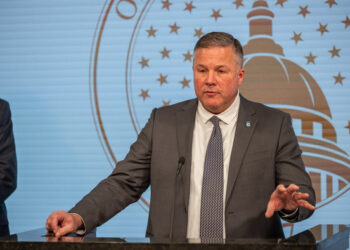




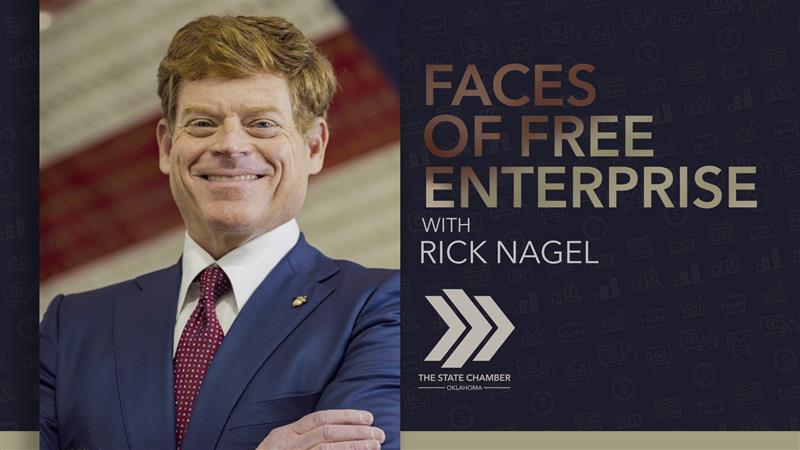

OKLAHOMA CITY (OBV) — The Faces of Free Enterprise series explores how capitalism lifts families and individuals. In the latest installment, State Chamber of Oklahoma Board of Directors Chair Rick Nagel sits down with Governor Kevin Stitt to trace the American dream, debate regulation, and outline a pro‑growth blueprint.
Read the entire transcript below.
Faces of Free Enterprise – State Chamber of Oklahoma
Rick Nagel interviews Governor Kevin Stitt
Editors note: This transcript was edited for clarity and brevity.
Rick: Welcome back to another episode of Faces of Free Enterprise, put on by the State Chamber of Oklahoma. My name is Rick Nagel. I’m serving this year as the chair. We started this series to talk about capitalism and all the good things about it—how it’s lifted families and individuals up. It’s been tied to the foundation of our country. Our American experiment—our Oklahoma experiment—is inextricably interwoven with it. It’s taken this whole nation to great heights as the leader in the free world and the largest economic power globally. But people have different definitions of it today. Some people aren’t so sure it’s the model we ought to have. Even when people come up here and talk about being pro-business, some have different ideas about what pro-business means anymore. So we put this series together to talk about these things. And I can think of no one better to be sitting down with right now than you—our 28th governor of the state of Oklahoma, Kevin Stitt—who, before getting into this, was an incredibly successful businessperson. Your story’s legendary: $1,000, a laptop computer, in 2000 you sat down and said, “I want to get into the mortgage business and make something great out of it.” Today, 42 states, $20 billion in mortgages that y’all are servicing today. Just an incredible story. You’ve gotten to see both sides of it—not only what it’s like to build a business, but now you’re on the other end of regulating businesses. There’s a balance there. We’re going to talk a little bit about that, but we’re excited to have you here today.
Governor Stitt: Thanks, Rick. I really appreciate it. And you’re not a bad business guy yourself. You’ve been very successful. This American dream is something I hope we get to talk about, because I think America is exceptional. This idea in our country that you can be anybody that you want to be. People are flooding here—this is where everybody wants to come around the world because of our freedoms, our free markets, and the ability to—you’re only limited by the dreams in your heart and how hard you’re willing to work for them. I think that’s something everybody needs to talk about. I’m so happy you guys are talking about this because sometimes big business gets a bad rap, but you forget about the employees and how they uplift and give everybody opportunity. Businesspeople have always been my heroes because they’re creating something, giving opportunities, and working with their friends. That’s what drives me. It’s not about making money. It’s about working with your friends, creating the right culture, achieving something, setting a goal, and winning. It’s fun to compete, and it’s fun to set big goals and dreams. You can accomplish them. Right here from Oklahoma, I think we have the best state in the country.
Rick: There’s no doubt, and I agree with you. I live here too. If you think about where Oklahoma is in the rankings with respect to competitiveness, cost of doing business, and overall regulatory environment since you’ve been governor working with the legislature—it’s moved from where we were to where we are now. In many cases, it’s climbed in every single category: number one in the country in overall cost competitiveness to do business. On and on and on. The stats have been amazing. Let’s talk about the American dream. It seems like it’s under attack. Fifty-three percent of Americans today think capitalism is a good idea—slightly more than that would describe it as free enterprise. But only 53% of America. We saw this election in New York with Mamdani—declared socialist. Some people are looking for a change. Why do you think that is? And how do we get the magic back?
Governor Stitt: I think there’s price pressure. Things are costing more. People are seeing costs go up. This idea that, “Am I going to be able to achieve a life better than my parents?”—those are real questions. So he’s tapping into a real concern or fear about a young person. But if you really study history and think about the alternative—free buses, taking over grocery stores, freezing rent prices—we understand, if you look and study history, that’s not a model that works. On the opposite side, more government regulation gets passed through and things cost more. When you overregulate something, you’re doing the opposite of what you intend. You’re hurting the people you’re trying to help—the rich get richer and the poor get poorer. The great thing about America is our strong middle class and this ability to go out and start a business, and then creating that free market that allows me to compete against you. When you deregulate something, you create that great middle class. It’s a different way to approach it. This is something we should all be talking about because that New York election was hitting on something: the cost of things is really concerning people. To me, it’s the growth of the federal government. We need to get the federal government under control. Our founding fathers talked about states’ rights and federalism. Oklahoma is different than California. We’re different than New York or Texas, and New Hampshire is different than South Carolina. When you allow the states to operate, that’s where real innovation comes from. The federal government should not be dictating a one-size-fits-all throughout the United States. Those are ultimately the problems we have right now. Prices are going up because we keep borrowing. That’s what’s devaluing the dollar. That’s what’s causing things to go up. I can see the real frustration, but the problem isn’t more government. The problem is we need less government to get the economy rolling.
Rick: Let’s pivot then. I couldn’t agree more with all of that. Well said. Let’s talk about Oklahoma. There is a balance that the government has with respect to regulating certain parts of business. If it goes too far, we get exactly what you’ve talked about. If it’s totally unchecked, it can go a different direction—we’ve seen that. Where do you think the right balance ought to be? I know that’s probably sector-specific, but when you’re up here dealing with lawmakers and lobbyists coming in from different angles, you have some looking for legislation to protect their moat—crony capitalism. In some cases, it’s completely deregulated. There are examples of that where maybe a little bit might have helped. How do you think about the balance?
Governor Stitt: That’s the million-dollar question. That’s the tough question. When I think about it, here’s something Oklahomans should really think about and contemplate as citizens: more government—usually they claim the higher moral ground. I’ll give you an example. If the highway patrol comes to me or the city of Edmond comes to me and says, “We need more police officers,” well, we’re for public safety. We support law enforcement. “Yeah, let’s give them more police officers.” Well, how many more? You can always hold the higher moral ground to say, “We need more.” “We need a thousand troops or a thousand police officers.” Well, isn’t 2,000 better than 1,000? How about 3,000? How about 4,000? If I’m a big-spending liberal, I can always come to you and say, “We ought to do more, we ought to do more, we ought to do more.” But the problem is eventually you’re going to run out of other people’s money. I’m always a smaller-government guy. We cannot take from you. Just because somebody in Washington, D.C. has some great idea that we need more government to fix this problem—how many ants are on the anthill of homelessness and food insecurity? I’m not saying that’s not a real issue, but you’ve probably got 400 programs at the federal level and 400 programs at the state level, and every church and every nonprofit. Ultimately, I don’t think you just pass laws and create more government to fix some of these social issues. Ultimately, it’s neighbors walking with neighbors, and people need good parents in the home. There are real issues with drug addiction that we need to fix. There are real problems with mental health issues. But just throwing more money, taking more money from the business community, and higher taxes—where all of a sudden we’re all beholden to big government—is not the answer either. So where does that line go? That’s the million-dollar question everybody fights about every single year. I believe we’re spending way too much and we need to rein government back in. I would propose a balanced budget amendment. Let Congress debate where to spend the money, but at least tell them they have to spend revenue. If me and Sarah—Sarah tells me, “Hey honey, I want a Ferrari,” I’m like, “Sorry honey, I only make this much money. Here’s what I can afford.” I can’t just continue to borrow and borrow and borrow. But our federal government seems to think there’s an unlimited checkbook, and it’s not realistic. We need to have an honest conversation as citizens to keep that in mind: do we really need it, or are they holding the higher moral ground telling us more is always going to fix things?
Rick: Agreed. It is situational, no doubt about it. We see examples of that all the time. One of the things that’s been interesting to me as a businessperson watching what happens is that, kind of like you, when people are running for office they all print up the brochure and everybody says they’re pro-family, pro-business. Pro-business is always there. But the votes don’t always come down that way. In your experience as governor, why do you think that is—that they don’t always score out to be on the side of business?
Governor Stitt: I’ve been here now for seven years, and it’s a very interesting question. You’re right—every flier says, “I’m for lower taxes, school choice, limited government, pro-business,” but when it comes time to cut taxes or limit government, what happens when you get here to this building is you get sucked into the lobbyist crowd and the “look how much more good we can do” mindset—back to that higher moral ground. “If we only had a little bit more money, we could do these other programs and help more people.” You fall into this. There’s less personal accountability and personal responsibility. We think we’re going to take care of everyone and fix every problem from Oklahoma City. That’s not real-world scenarios. The other thing is the money is always on the yes side. What I mean by that is: who’s going to benefit from this piece of legislation if it passes? The industry pushing that bill is going to hire the lobbyist. They have the money because they’re going to benefit from it, so they put money on the yes side. The taxpayers aren’t coming in hiring lobbyists to say no on that bill. So all the pressure for the legislature is on the yes side. That’s why I look at myself as well—I’ve got to represent the taxpayer. I’ve got to be the no guy. I’ve got to be the guy that says, “No, we’re not going to do that. I’m going to veto that. I’m not going to go for that.” You get caught up in this momentum, and there’s a lot of pressure in this building, whether it’s Washington, D.C. or here, where you get caught up in going with the flow. “I don’t want to make this group mad or this group mad because I’m going to be up for election in two years.” You fall into this trap of, “I’m only one person. I really can’t fix it. I’ll just go along with the crowd.”
Rick: You’re in your second term. You’ve done a lot to help make Oklahoma more competitive. We’ve had a lot of wins. What more can we do to create that American dream economy where folks want to come here, start a business, and have everything they need to be successful? What’s left?
Governor Stitt: If I take you back to 2018 when I was running, what got me passionate about serving my state is we were not performing well. We were having teacher walkouts. There were billion-dollar budget deficits. Our savings account had zero money in it. I was like, “What is going on? This is my state. I’m a fourth-generation Oklahoman, and we could do so much better.” I saw Texas thriving, Florida, and Tennessee. I thought we need a businessman governor. Now we have the largest savings account we’ve ever had. I’ve cut taxes. We’ve got school choice. I’ve done tort reform. We’re a pro-business state. We have a $14 billion investment just this year—new investments in Oklahoma—to record. I’m really proud of all that. So what can we continue to do? We have to continue this momentum. I think it’s stacking a couple of good businessmen governors together, back-to-back. Tennessee had three really good businessmen governors back-to-back, and they took their state to zero income tax. That’s where you see the car industry and manufacturing exploded. Tennessee’s really doing well. Tennessee was not a top-tier state 20 years ago. We can do that if we elect the right businessman governor and continue this momentum of limited government. Let’s get government out of the lives of business. Let’s be the most pro-business state. I was just in Singapore. Singapore is a country that’s like the size of Rhode Island, with about 6 million people. Because they’re so pro-business, they exploded. Internationally, all the companies want to locate there. We should be the headquarters capital of the world right here in Oklahoma City. That’s what I’m driving for. Energy is another big deal. I passed behind-the-meter. It’s also a free market approach. We love our public utilities. We want them to create more generation. But if they’re going to hold you hostage to higher prices, I passed a bill that allows a company to come in—private, individual—and put your own gas turbine with gas and then create your own electricity for your factory or your data center. I think that’s going to be a huge differentiator for us. So: energy, getting the right person, keeping our pro-business policies, and Oklahoma’s going to continue this upward climb.
Rick: If you’re a young, aspiring businessperson in America today, you see this interview, and you have a chance to give them your pitch on why Oklahoma—how would you frame it for them?
Governor Stitt: Oklahoma is the way. Think of the U.S. as this American dream—come to Oklahoma and you can accomplish your dreams from right here. You mentioned it earlier: there’s an arbitrage right now on labor cost and cost of living. Why pay $250,000 for an engineer in California when you can get them here for $150,000? That’s why I have this international strategy where I’ve met with 80 different ambassadors, because foreign companies a lot of times all they know is New York or L.A. from the movies. I tell them: that’s the worst place to set up a business. You want to come to Oklahoma and Texas—the places where family still matters, faith is important, and hard work is appreciated. We appreciate when capital is invested. Regulators don’t come after businesses—we work with businesses. I signed an executive order that blows people away: if we don’t have our permits done within 30 days, they’re free, because I want my regulators moving at the speed of business. People know we’ll get your projects done quickly. We won’t be playing gotcha. We want to help people grow. We’re not going to be attacking businesses like I see in other states. I also passed business courts because I saw businesses being attacked in the court system in New York and Delaware starting to stumble. Elon pulled out of Delaware and their court system. We wanted to pass that to get Oklahoma’s court system more pro-business as well.
Rick: If you’re trying to appeal to young folks right now that are on the fence about what form of government is best—socialist big government, more control, regulated industries to the point where they look like government—versus free market, how do you make that easy for somebody who’s just thinking about this for the first time?
Governor Stitt: Take an economics class. Take supply and demand. Understand what drives prices. Do some research. Go move to Cuba for a while. Look at the GDP of Venezuela before and after. Go look at Russia’s economy and how government control affects the quality of life. They don’t know how lucky they have it in the U.S. That’s why people want to flood here. Socialist policies—if you look at the Democratic platform, and there are good Democrats out there that believe in fiscal discipline, but there are some that want 100% government control. Mamdani that just got elected in New York is talking crazy stuff. If you think about that, it will lead to socialism, which is government controlling every single thing in your life. At the core of that is freedom. You get to vote with your wallet. I don’t have to buy your product. You don’t have to sell it to me. We have the freedom to exchange or not. That’s at the core of it.
Rick: Governor Stitt, thank you very much for your time. Thank you so much for leading our state these last seven years. You’re getting ready to come into the most exciting one yet—number eight—your last year. We’re expecting big things. Thank you so much for your leadership and sitting down with us here today.
Governor Stitt: Thanks, Rick. Appreciate you, buddy.