





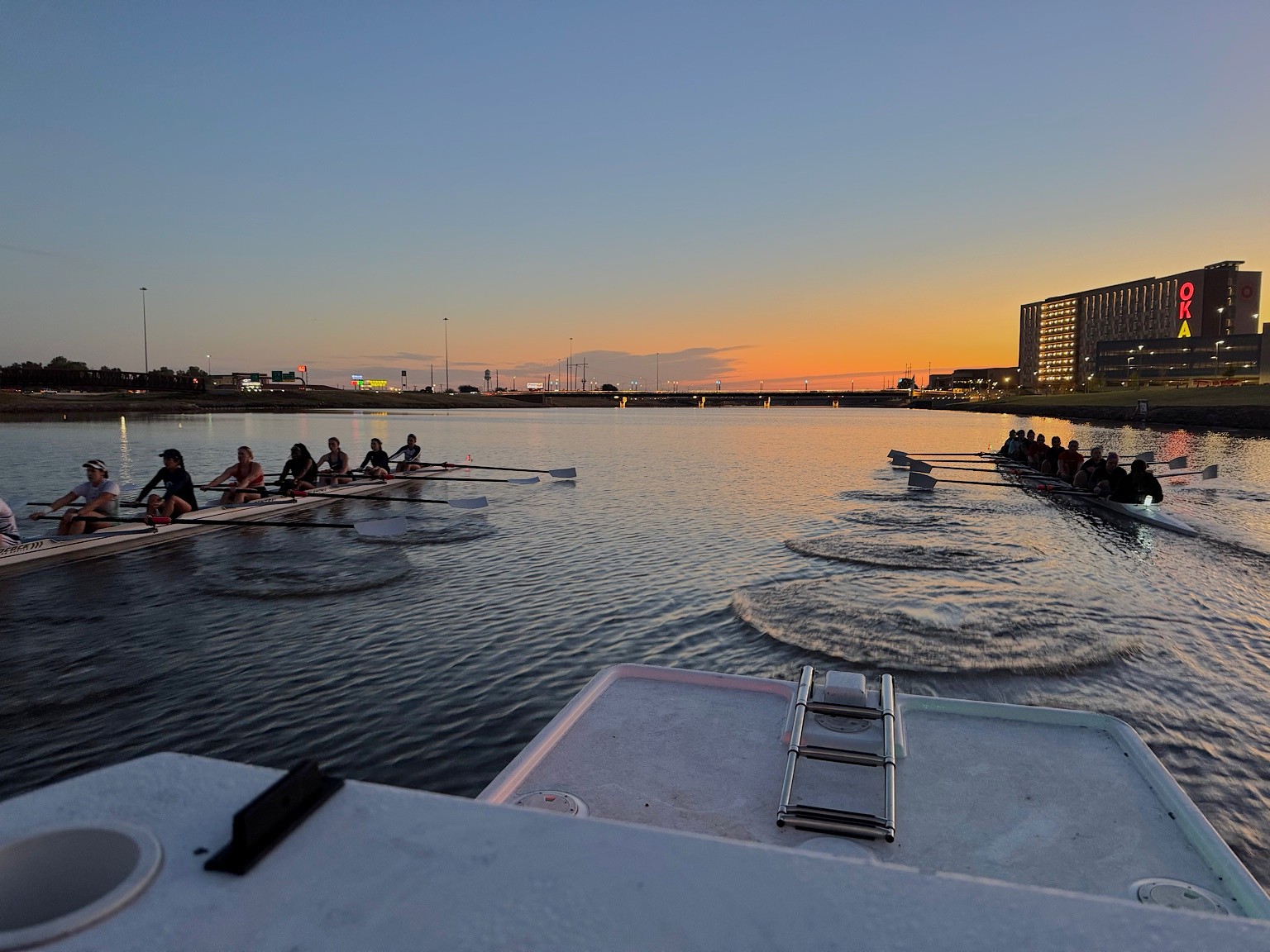

Everyone who knows me knows one thing: I care deeply about rowing.
The water, the athletes, the strange magic of eight people moving as one. Rowing is, and has always been, the anchor that grounds me. It is honest. It is repetitive. It is technical. It is teamwork with nowhere to hide. And it has a way of reducing big ideas down to one simple truth.
The clock does not care.
That is why a phrase like “sustained 3% growth” landed with me when I listened to the U.S. Chamber’s State of American Business address. Not because I’m captivated by an economic slogan, but because rowing has trained my brain to take pace seriously. In rowing, small differences compound fast, and the outcome is often decided by a margin that looks ridiculous on paper. At the highest level, first and second can be separated by less than a second.
That is rowing in a nutshell. Tiny margins, massive meaning.
Now take that lens and point it at Oklahoma. Three percent is not a sliver. Three percent is a tempo. Three percent is a pace you can build a strategy around. It is the difference between feeling like the future is expanding and feeling like you are stuck protecting what you already have. In rowing terms, it is the difference between moving with momentum and rowing in place.
That is the part I want to pull back to Oklahoma.
In a recent OBV conversation, economist Dr. Steven Agee put it plainly. He expects Oklahoma to keep growing in 2026, but at a slower, more cautious pace, with energy softness and persistent inflation pressures shaping business decisions. He also emphasized something that is hard to argue with. Education and workforce preparation are what determine whether Oklahoma can capitalize on future growth.
That is exactly why the work we are doing through Oklahoma Competes matters so much right now.
Oklahoma Competes is a long-term, data-driven framework to strengthen the state’s competitiveness, built around four fundamentals: economic climate, education and workforce, infrastructure, and innovation and entrepreneurship. What I appreciate about that approach is how it keeps the conversation grounded. It gives us a shared set of facts. It helps us see where Oklahoma is gaining ground and where we still have work to do. It also makes it easier to align around practical steps that strengthen opportunity for Oklahomans and competitiveness for employers.
When you talk to business leaders across this state, you hear a consistent theme. They are not asking for miracles. They are asking for a pipeline that works.
A pipeline that starts early, because it is hard to talk about “workforce” if a child cannot read confidently.

When you talk to business leaders across this state, you hear a consistent theme. They are not asking for miracles. They are asking for a pipeline that works.
A pipeline that starts early, because it is hard to talk about “workforce” if a child cannot read confidently.
– Luke Reynolds, Managing Editor of Oklahoma Business Voice
A pipeline that respects all paths, including career tech, apprenticeships, credentials, community colleges, and four-year degrees.
A pipeline that makes it easier for people to see a future here, build a life here, and stay here.
That is not abstract. It is basic competitiveness. Oklahoma Competes gives us a way to organize that work and keep after it, year after year, instead of treating workforce like a series of one-off projects.
And from a rowing perspective, it is also common sense. If you are serious about winning, you do not just hype the race. You build the program. You recruit. You develop. You train. You make the fundamentals repeatable. You do the boring work that creates the exciting outcomes.
Workforce is the same. A strong economy needs people. It needs skilled people. It needs training pathways that make sense. It needs employers who can partner with education and training providers without reinventing the wheel every time. It needs a state that treats talent like infrastructure.
The point is not to pretend 2026 will be effortless. It probably will not be. Slow growth still means growth, but it also means decisions feel tighter, and planning matters more. That is when the fundamentals stop being theoretical and start being the whole game.
So if we are serious about growth, if we are serious about opportunity, if we are serious about keeping Oklahoma competitive, we build the fundamentals. We strengthen the talent pipeline. We measure what matters. We do the work that makes the boat move.

Luke Reynolds is the managing editor of Oklahoma Business Voice. He can be reached at luke@okstatechamber.com.