







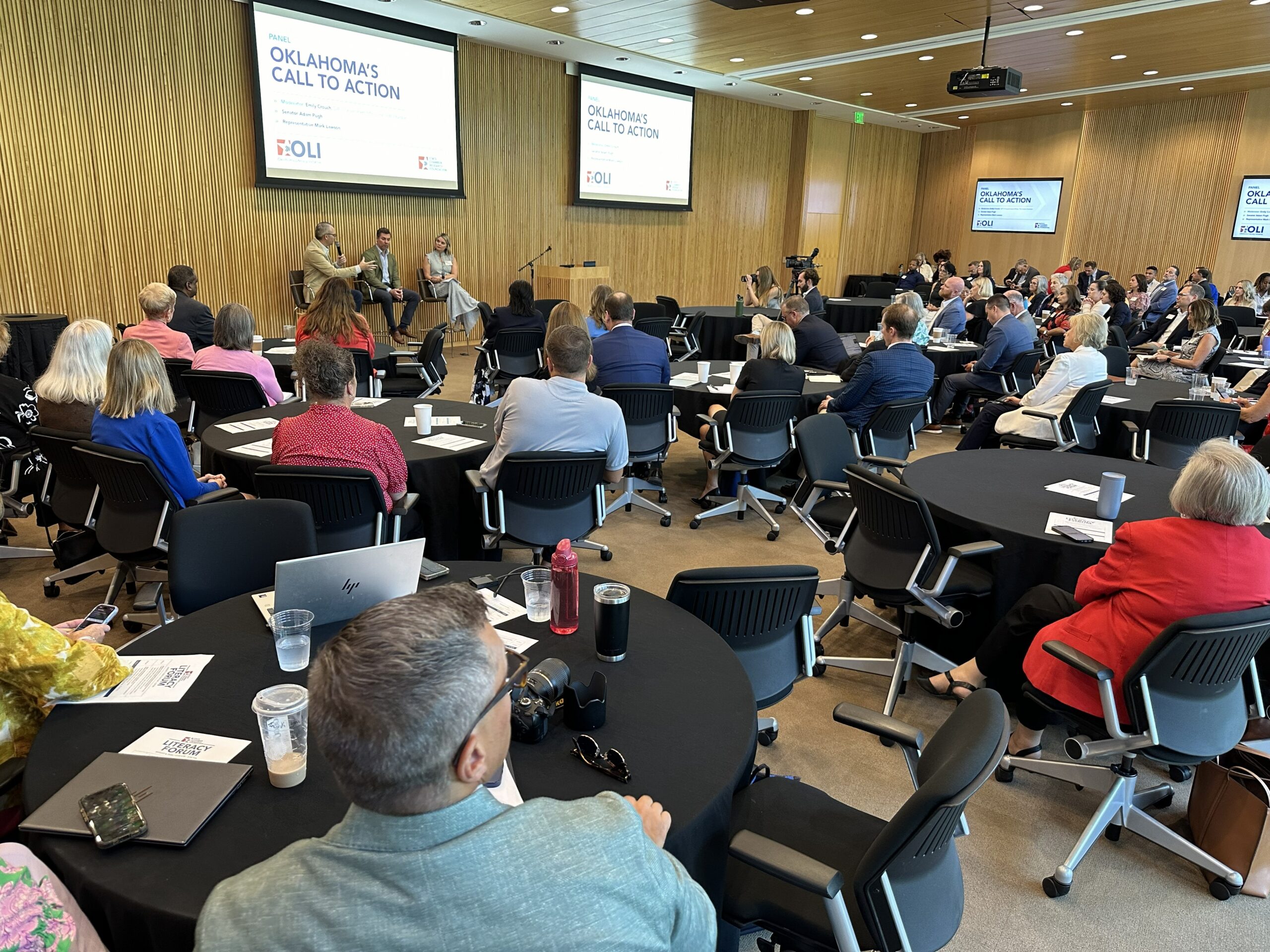

OKLAHOMA CITY (OBV) — The Oklahoma State Chamber Research Foundation launched the Oklahoma Literacy Initiative Tuesday during a statewide forum focused on improving early reading achievement and sustaining literacy reform inside Oklahoma classrooms.
The privately funded pilot will partner with 10 urban, midsize, and rural school districts: Beaver, Burns Flat-Dill City, Oklahoma City’s W.K. Jackson Leadership Academy, Tulsa, Okmulgee, Meeker, McAlester, Maysville, Ardmore, and Valliant.
Participating districts will receive intensive professional learning, classroom coaching, instructional modeling, and ongoing support grounded in the Science of Reading. Independent evaluation will track student growth, instructional effectiveness, and implementation throughout the pilot.
“The Oklahoma Literacy Initiative is about creating lasting change, not simply delivering professional development,” said Jake Yunker, executive director of the Oklahoma State Chamber Research Foundation. “Our goal is to build sustainable systems that empower educators, strengthen instructional practice, and demonstrate how high-quality implementation of the Science of Reading can improve literacy outcomes for students.”
The announcement opened the State Chamber Research Foundation’s Literacy Forum at the Peake in Oklahoma City. Yunker was joined by State Chamber President and CEO Chad Warmington and foundation board President Kristin Peck for the initiative’s introduction and the announcement of participating districts.
The remainder of the forum examined how Oklahoma can translate new laws and educational priorities into consistent classroom practice.
A panel moderated by Jeff Dean of the Walton Family Foundation featured Kunjan Narechania of Watershed Advisors and Casey Taylor of ExcelinEd. The discussion focused on lessons learned from statewide reading reforms and the long-term work required to implement them successfully.
John White, former Louisiana state superintendent and CEO of Great Minds, delivered the keynote address remotely. White said Oklahoma’s Strong Readers Act and Math Proficiency Act are drawing attention from education leaders across the country, creating an opportunity for the state to become a national leader in implementation.
He cautioned that passing legislation represents only the beginning of that work.
“Education does not change overnight,” White said. “This is a behavioral policy issue, and human behavior, at the scale of the entire system in the state of Oklahoma, will not change on a one-to-two-year timeline.”
White pointed to Louisiana’s gradual improvement in student performance as an example of how states can sustain education reform across changing political administrations. He said Louisiana developed a statewide approach built around high-quality instructional materials, teacher training tied directly to the curriculum, accountability, and a coherent system for directing resources toward implementation.
He outlined three principles for Oklahoma: political durability over time, continued accountability for results, and a rigorous implementation system connecting state policy with the daily work of districts, school leaders, and teachers.
“The hard work is yet to come,” White said.
White said successful implementation requires the state to define what strong instruction should look like, ensure students have access to evidence-based curricula, and give teachers practical training in how to use those materials. He also encouraged Oklahoma to identify early-adopter districts, celebrate their progress, and allow them to demonstrate successful practices before expanding reforms statewide.
Questions following the keynote addressed the growing number of alternatively and emergency-certified teachers, cooperation between state and local education leaders, professional development requirements, and how Oklahoma can prevent reforms from being reversed during future political transitions.
White said inexperienced teachers particularly benefit from a consistent curriculum and training focused on the specific materials they will use each day. He also emphasized that lasting reform cannot depend on a single governor, state superintendent, or legislative session. Business organizations, education advocates, lawmakers, and other outside partners must maintain support for the work over time.
The forum continued with an Oklahoma call to action featuring Sen. Adam Pugh and Rep. Mark Lawson. National literacy expert Antonio Fierro later discussed the connection between literacy and the business community.
The Oklahoma Literacy Initiative is part of The State Chamber’s broader Oklahoma Competes vision for improving the state’s long-term economic competitiveness. Organizers said stronger early reading outcomes will support academic achievement while building a more prepared education-to-workforce pipeline.
“Oklahoma’s future depends on the success of today’s students,” Warmington said. “Strong reading skills are the foundation for everything that follows, from academic achievement to workforce readiness and economic opportunity.”