Beneath the wings of the Winnie Mae, Oklahoma celebrates a $52.5 billion aerospace industry
A gathering beneath the History Center’s replica Winnie Mae celebrated an aerospace and defense industry supporting more than 250,000 jobs, with leaders pointing to the workers and investments behind its growth.
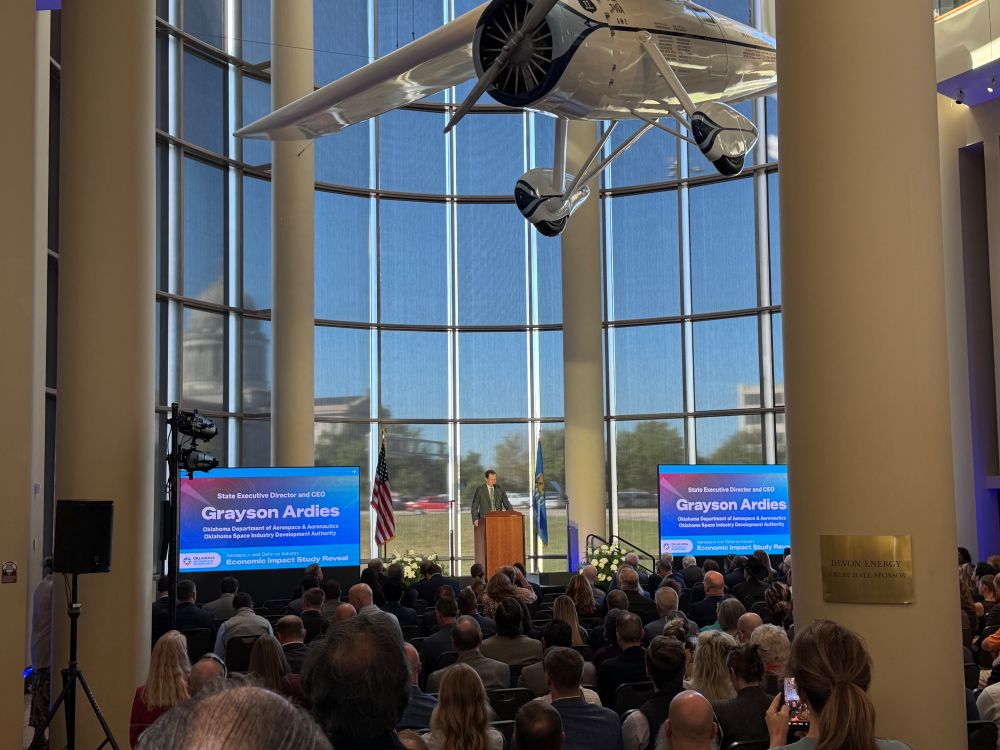
OKLAHOMA CITY (OBV) — Beneath the wings of a replica of Wiley Post’s Winnie Mae, Oklahoma leaders gathered Oct. 6 to put a new number on an industry woven into the state’s history: $52.5 billion.
The airplane suspended above the Oklahoma History Center’s Devon Great Hall recalled the aircraft Post flew around the world in 1933. The conversation below it centered on the Oklahomans building, maintaining, and flying the next generation of aircraft.
For Gov. Kevin Stitt, the connection was personal. He recalled learning to fly at Norman’s Westheimer Airport as a teenager.
“But there’s something about seeing a state from the sky that really makes you appreciate it,” Stitt said.
The occasion was the release of the Oklahoma Department of Aerospace and Aeronautics’ economic impact study, which put the aerospace and defense industry’s annual statewide economic activity at $52.5 billion, supporting more than 250,000 jobs.
Stitt also reported $16.6 billion in annual payroll associated with the industry. He emphasized the opportunities behind those figures, from engineering and aircraft maintenance to software development, and the workers who entered the field through CareerTech.
“They learned a skill, they built a career, a life for their families,” Stitt said.
The study showed growth across every major industry segment since the department’s 2017 report. At the History Center, state and federal officials joined industry representatives to celebrate that expansion and discuss what it will take to sustain it.
In a statement following the announcement, Senate President Pro Tempore Lonnie Paxton, R-Tuttle, pointed to the combination of employers and workers behind the results.
“Oklahoma has built a reputation as a place where businesses can grow, workers can build careers and employers can find the talent they need,” Paxton said.
Lt. Gov. Matt Pinnell illustrated that growth through companies investing in Oklahoma. He highlighted projects ranging from Dawn Aerospace’s spaceplane operations at Burns Flat to Manna’s drone delivery business in Tulsa and Pratt & Whitney’s military engine operations in Oklahoma City.
“These are different companies, different technologies, and really different paths for the state,” Pinnell said. “It just shows you how diverse it is, but they’re all making the same decision. That Oklahoma is a place where aerospace can grow.”
Those decisions depend on the work happening before a company arrives, Pinnell said, including classroom instruction, technical training, and investments in airports.
“The workforce, the runways, the hangars, the terminals, it does not happen on its own,” he said.
U.S. Rep. Tom Cole focused on the relationship between Oklahoma’s military installations and the companies that support their missions. He discussed the continuing investment needed at Tinker Air Force Base and the role of private employers in building and maintaining the nation’s defense capabilities.
“But we’ve got this enormously capable private sector that is the backbone of giving us the weapons systems and helping us maintain them that we need,” Cole said.
The next phase of growth will also depend on preparing enough workers to fill those jobs, according to Sen. Kelly Hines, R-Oklahoma City, a retired Army colonel and chairman of the Legislature’s Aerospace Caucus.
“Strengthening the workforce pipeline, supporting the infrastructure that keeps aviation and aerospace operations running and sustaining the systems that fuel innovation is essential to ensuring Oklahoma remains a national leader in this critical field,” Hines said in a statement.
For Senate Appropriations Chairman Chuck Hall, R-Perry, the industry’s reach extends far beyond its largest employers.
“Aviation and defense companies are driving record growth in communities of every size, from our smallest rural towns to our major metropolitan areas,” Hall said.
He credited regional and municipal airports with connecting those communities to customers, visitors, and investment.
“These airports fuel economic development, support thousands of local jobs and bring new visitors and investment into our state,” Hall said.