





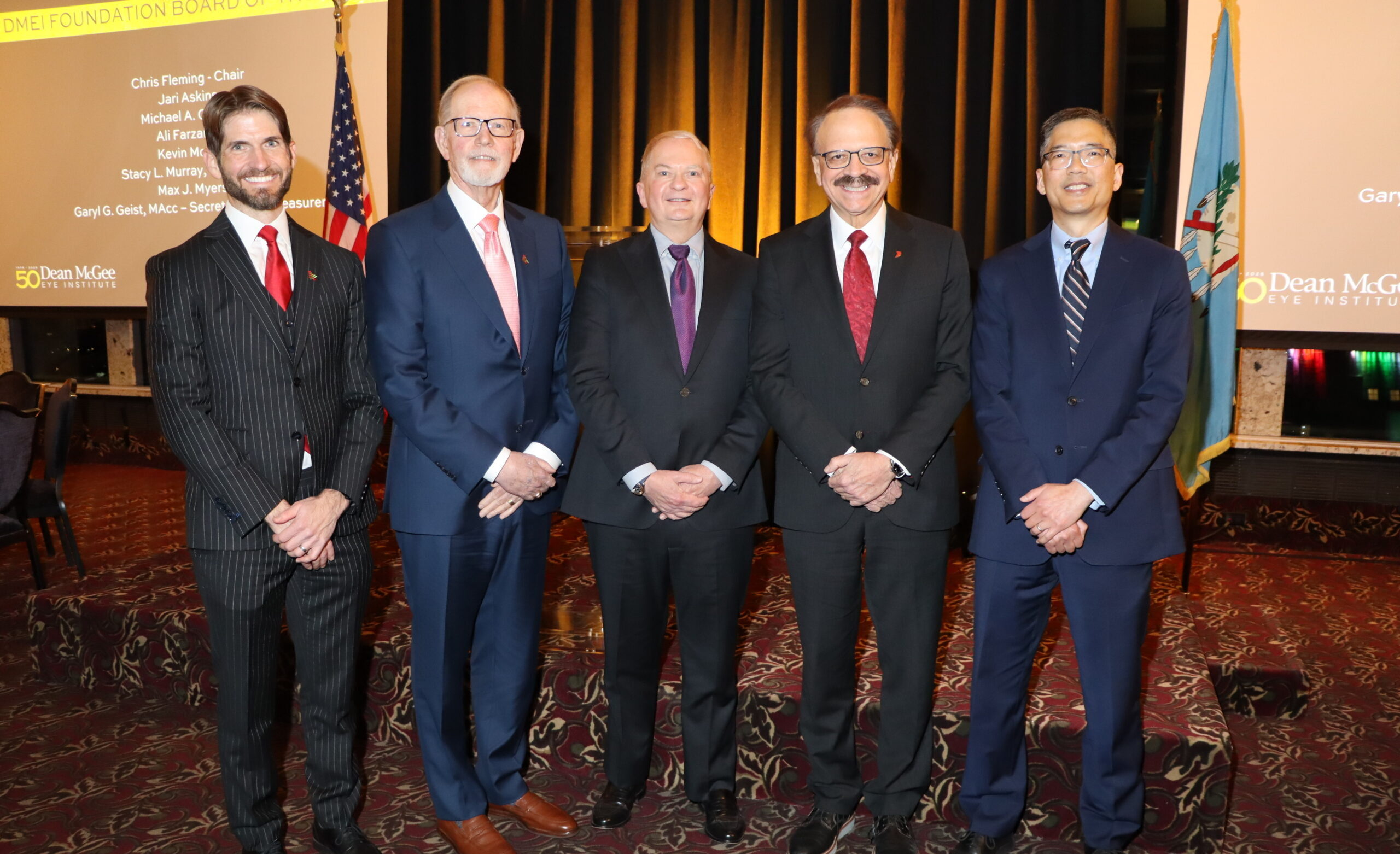

OKLAHOMA CITY (OBV) — One of America’s leading medical centers for eye care is celebrating its 50th birthday in December. The Dean McGee Eye Institute (DMEI) is becoming a part of OU Health, Oklahoma’s flagship academic health system, January 1, 2026, which will expand its patient care and research capabilities.
“I think the most important asset of any successful organization is the people. It starts with the people,” said Dr. R. Michael Siatkowski, the Chief Executive Officer of the Dean McGee Eye Institute and the Edward L. Gaylord Professor and Chair of the Department of Ophthalmology.
“Fifty years ago, they had the vision for Dean McGee and put it together. We have evolved into a large organization. We have outstanding doctors,” said Dr. Siatkowski. “They have excellent training. They’re high quality, compassionate, and ethical.”
Since its dedication on December 4, 1975, DMEI has gained a national reputation as a vision leader with the three-pronged mission of clinical eye care, medical education and vision research. Dean McGee Eye Institute is one of America’s largest and most respected centers for medical and surgical eye care. Nearly a quarter of a million patient visits are made each year to its five clinic locations in Oklahoma City, Edmond, and Lawton. Patients come from all 77 Oklahoma counties and many surrounding states.
“In addition to doing a lot of volume and being an economic generator for the state, we’re a critical part of the public health fabric of Oklahoma,” said Dr. Siatkowski. “Without us, there would be a lot of people who would have to leave the state to get care, or even worse, may not get the care that they need at all.”
DMEI’s ophthalmology residency program, under the University of Oklahoma College of Medicine, will continue to train future ophthalmologists, as the Dean McGee Department of Ophthalmology at the University of Oklahoma College of Medicine through robust residency and fellowship programs and conduct research and clinical trials that advance the science and innovation of eye care. The fellowship programs bring the best and brightest to the institute for specialized training. A significant proportion of the ophthalmologists in Oklahoma are graduates of the DMEI/OU program. Officials say nearly 40% of the residents trained at DMEI stay in the state.
Dr. Siatkowski says a lot has changed in the five decades DMEI has been serving Oklahoma. There have been huge steps in patient recovery time from cataract surgery and minimally invasive glaucoma procedures. But the biggest difference, ironically for an eye institute, is being able to better see issues within the patient’s eye itself.
“Almost every field of ophthalmology has seen dramatic advances in the last 50 years. But if I had to put it all together, I’d say the one unifying theme overall is imaging,” said Dr. Siatkowski. “Now we’re able to look at the eye almost down to the sub-microscopic level with different instruments that we have right in the office.”
“You can take a picture. You can see the tiny, little blood vessels in the eye, the different layers of the retina or the different fibers that feed into the optic nerve,” said Dr. Siatkowski. “It’s incredible what we’re able to see now.”
Over the past half-century, DMEI’s vision scientists have been on the leading edge of research to understand the causes of eye disease and use that knowledge to undertake novel treatment approaches. DMEI researchers remain focused on accelerating new breakthroughs in such areas as retinal degeneration, glaucoma, and infectious and inflammatory diseases of the eye.
DMEI has trained over 300 talented residents and fellows to address the shortage of physicians in Oklahoma and in the nation and has made significant scientific advances, which will lead to new treatments and preventions of visual loss.
Dr. Siatkowski also says DMEI is about to enter a formal integration with OU Health, starting in January 2026. With the acquisition, OU Health will operate DMEI clinics and operating room services.
“We are very excited moving forward. There’s going to be a lot of synergy that’s going to help us do what we do better with more resources,” said Dr. Siatkowski. “The integration will help us to be more effective for the people of our city and our state.”