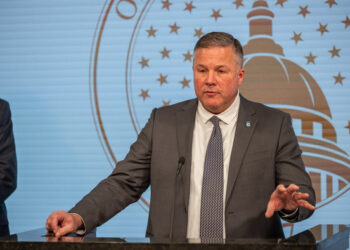






OKLAHOMA CITY (OBV) — The House Appropriations & Budget Education Subcommittee voted 8–2 Friday to advance HB 4420, Speaker Kyle Hilbert’s early‑literacy package built around statewide screening, science‑of‑reading instruction, expanded interventions, strengthened parent notifications and a reaffirmed third‑grade proficiency bar with good‑cause exemptions.
The bill, filed Jan. 15 and assigned to the A&B Education Subcommittee on Feb. 3, now heads to the full Appropriations & Budget Committee.
Hilbert opened the February 16 subcommittee meeting with a blunt assessment of Oklahoma’s literacy slide and framed the bill as an accountability‑plus‑support approach grounded in research.
“In 2015, Oklahoma students performed near the national average in reading. Today, we trail poorer states by more than a full grade level. Only 27% of Oklahoma third graders are reading at or above grade level,” he said. “Before the third grade, students are learning to read; after the third grade, they’re reading to learn. This is not about punishment. It’s about ensuring kids can read.”
Members pressed for a roadmap to replicate other states’ gains and for clarity on methods. Hilbert repeatedly pointed to Mississippi’s experience while noting HB 4420’s method guardrails, including a prohibition on three‑cueing for students with reading deficiencies and a single statewide screening instrument selected by the State Department of Education after a CEQA evaluation.
The committee then dug into resources and rollout.
Rep. John Waldron, D-Tulsa, on the asked whether Oklahoma is prepared to fund the training, specialists and coaching necessary to carry out the plan.
Hilbert said funding would be “essential” and that OSDE is working to finalize numbers. He highlighted a new revolving fund in the bill to accept private and philanthropic donations—opening the door to business, nonprofit and tribal participation alongside state dollars.
Lawmakers also pressed on capacity in early grades given vacancies and adjunct reliance. Hilbert pointed to the Inspire to Teach scholarship/retention program and said he supports tightening rules so K–4 classrooms do not rely on adjunct certifications, with pathways toward full certification for those currently teaching under adjunct status. He added that aligning teacher‑prep programs to the science of reading remains part of the push.
Retention drew sustained questioning. One member warned that, even with exemptions, a large share of students could be held back and asked whether schools will have enough reading specialists, coaches and aides to deliver intensive help. Hilbert answered that exemptions would reduce the raw number and underscored his trust in educators to implement the model, while acknowledging the need for better state data on where reading specialists are placed and how many are available.
Several members and the chair invoked Oklahoma’s earlier gains and subsequent policy reversals. The chair said lawmakers “listened to the wrong voices” a decade ago and urged a return to evidence‑based practices embraced in the region’s “Southern Surge.”
Hilbert agreed, calling HB 4420 and a related literacy measure heard earlier a course correction aimed at “demanding better outcomes for our kids.”
HB 4420’s text lays out the mechanics: stronger, earlier parent notifications when a child is behind; intensive, science‑of‑reading interventions from kindergarten through third grade; tighter portfolio evidence for promotion; a defined good‑cause request process; and an acceleration class for students retained more than once. The bill also ties certain reporting to accreditation and clarifies skills assessed in screenings.
What happens next: With subcommittee approval, the measure is eligible for a hearing in the full House Appropriations & Budget Committee. If advanced, it moves to the House floor for third reading and final House passage before repeating the process in the Senate. If both chambers agree on a final version, the bill goes to the Governor.