Renewables deliver stability for Oklahoma growers, rural communities
How wind and solar leases are supporting Oklahoma growers and rural communities.
OKLAHOMA CITY (OBV) — As Oklahoma continues to expand its role as a national leader in renewable energy production, landowners across the state are weighing what wind and solar development mean not just for the grid, but for the long-term health of agricultural operations and rural communities.
For many growers and producers, renewable energy is less about politics or power generation and more about financial stability in an industry where margins are often unpredictable.
“Landowners sign leases first and foremost for the revenue,” said Destinee Weeks, development director for Allegiant Land Services, who works with landowners on renewable energy development. “The stability of consistent, long-term payments can make a meaningful difference to the bottom line.”
That predictability, Weeks said, can have ripple effects well beyond the lease itself.
“Another key advantage is that this predictable income stream can enhance land value and strengthen borrowing capacity by providing lenders with guaranteed revenue,” Weeks said. “That, in turn, allows landowners to invest in improvements, support their operations, and secure needed loans or lines of credit.”
Compatibility with working land
One of the most common concerns among producers considering renewables is whether projects will interfere with day-to-day agricultural operations. According to Weeks, wind energy projects in particular are designed to coexist with existing land uses.
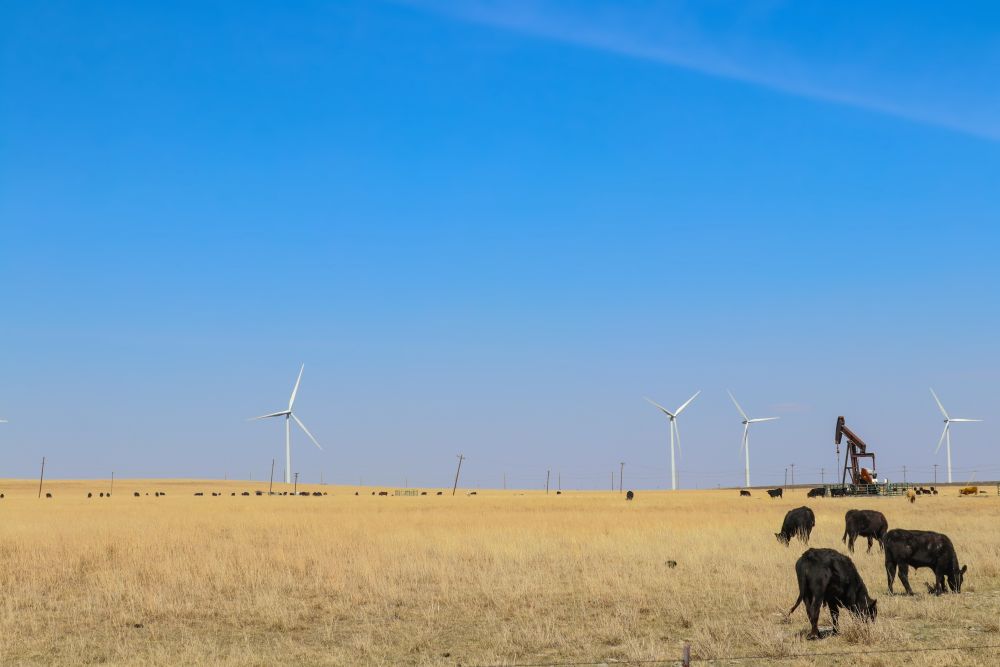
“A wind turbine and its access road typically take only about one to two acres out of production,” Weeks said. “The actual footprint is minimal. You can farm around a turbine or run cattle near it, much like you would with an oil well.”
In many cases, she added, turbines generate outsized returns relative to the land they occupy.
“To my knowledge, there’s nothing that can generate more revenue on a single acre than a wind turbine,” Weeks said. “It’s a small footprint with a significant financial return.”
Weeks also noted that infrastructure improvements tied to wind development can enhance the usability of the land itself, drawing on her family’s experience leasing land used for wheat farming and a cow‑calf operation.
“On ground I’ve personally leased, turbines have even improved usability,” she said. “Some of the terrain was rough and difficult to access, but once the turbines were built, the access roads created valuable entry points across the property that made it much easier for us as tenants to operate.”
Solar development presents a different equation. While solar facilities require more continuous acreage, Weeks emphasized that they rarely displace entire farming operations.
“Solar is different. You’re obviously not farming wheat under solar panels,” she said. “That said, solar projects only use a portion of a farm. Utility-scale solar occupies roughly 0.1% of the country’s agricultural land.”
“Most landowners who lease for solar don’t stop farming altogether,” Weeks added. “They use the lease revenue to support the rest of their operation or even expand by purchasing additional land.”
Visible community impact
Beyond individual landowners, renewable energy projects can play a significant role in strengthening rural counties through increased tax revenue and infrastructure investment.
“County revenues make the biggest difference,” Weeks said. “Renewable projects bring in substantial ad valorem tax revenue to counties that otherwise have limited new tax base.”
She pointed to Seiling as a tangible example.
“You see it directly in schools,” Weeks said. “Seiling has a brand-new school facility, something that would have been very difficult to achieve without a strong, consistent tax base. That is a direct investment back into the community and its future.”
Infrastructure improvements tied to construction often extend well beyond the life of a project’s build phase.
“Roads and bridges are upgraded to handle construction, but those upgrades do not go away,” Weeks said. “Counties end up with safer, more reliable roads and better access across rural areas, which benefits farmers, ranchers, and emergency services long after the project is built.”
Local services also benefit from the expansion of the tax base, particularly in small communities.
“With increased revenue, counties can better fund fire departments, equipment, and other essential services that are often stretched thin in rural areas,” she said.
Supporting generational agriculture
For families considering renewable leases, Weeks said the conversation often centers on long-term goals for the land itself.
“For producers considering a renewable lease, it really starts with one question: what are your long-term goals for the land?” she said.
While some landowners may see added value in resale potential, many are focused on preserving family operations.
“For many families, the goal is the opposite,” Weeks said. “It is not about selling, it is about keeping the land.”
“Agriculture is tough and margins can be unpredictable,” she added. “Having a guaranteed, long-term revenue stream can be the difference between holding onto generational land and being forced to sell.”
That stability can provide producers with flexibility during downturns.
“Instead of selling off acres during hard times, they can use lease income to support the rest of the operation, invest in improvements, or even expand,” Weeks said. “In that way, the lease is not replacing agriculture, it is helping sustain it.”
Private property rights and diversification
Weeks emphasized that renewable development in Oklahoma is built on voluntary participation, aligning with the state’s long-standing emphasis on private property rights.
“These projects are built on voluntary agreements,” she said. “Landowners choose whether or not to participate. No one is forced into a lease, and terms are negotiated directly with the landowner.”
She contrasted that approach with broader policy proposals that could limit landowner choice.
“When policy removes or severely limits a landowner’s ability to participate, it is no longer a private decision,” Weeks said. “It is the government stepping in to decide how that land can be used.”
From an economic standpoint, renewables add another layer to Oklahoma’s energy identity.
“Oklahoma has always been an energy state, and renewables simply add another layer to that identity alongside oil and gas,” Weeks said. “That diversification strengthens rural economies by bringing in construction jobs, ongoing operational roles, and steady outside capital.”
At the community level, the impact is both financial and cultural.
“It dumps big-city money into rural communities, while allowing those same communities to remain rural,” she said.
“At the end of the day, these projects work because they align with two core principles,” Weeks added. “They respect the right of landowners to make decisions about their property, and they inject long-term economic support into rural communities that need it.”