





State Question 832 would raise Oklahoma’s minimum wage to $15 an hour by 2029. Beginning in 2030, it would automatically increase every year based on the federal Consumer Price Index for Urban Wage Earners and Clerical Workers, or CPI-W.
Those automatic increases would continue indefinitely and would not require approval from Congress or the Oklahoma Legislature, according to the official ballot title.
Recent history shows the national CPI-W and Oklahoma-specific price growth do not always move at the same rate.
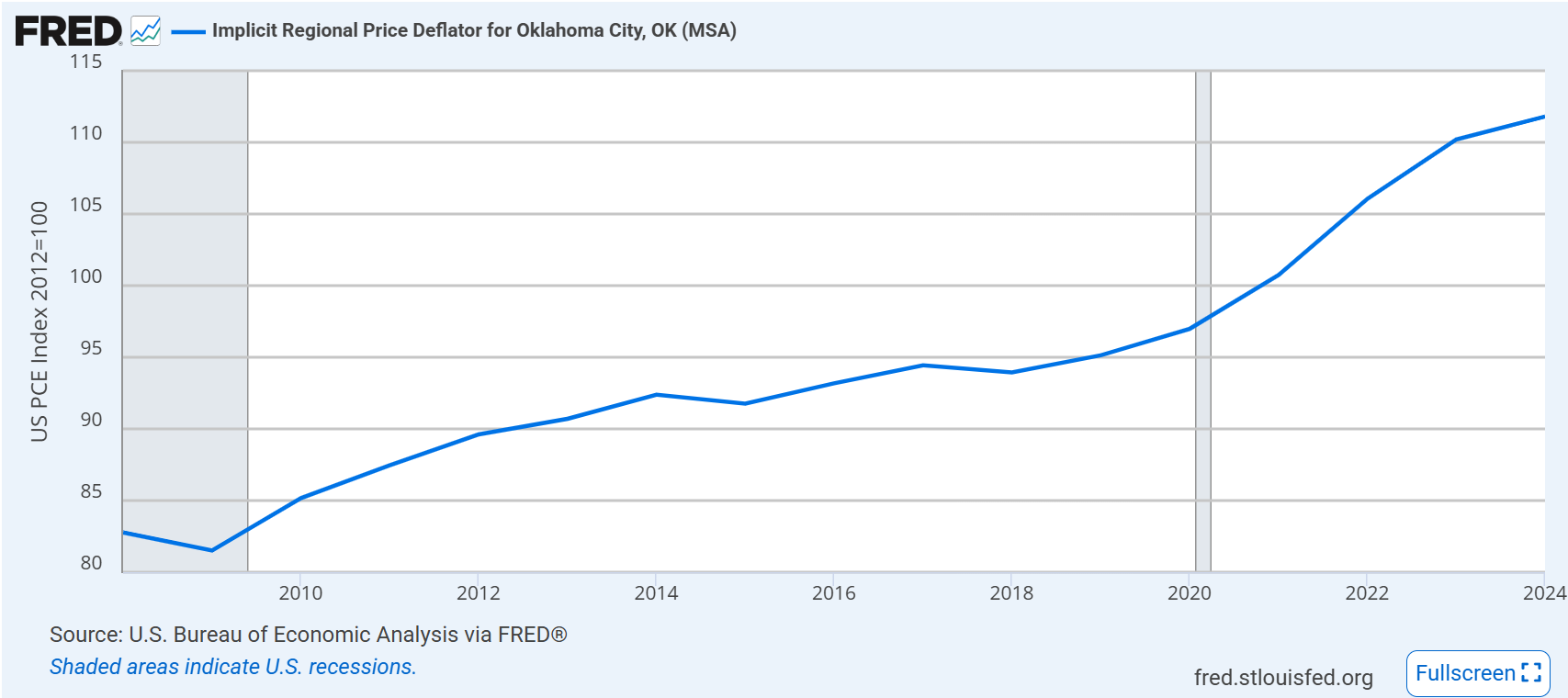
In 2022, the national CPI-W rose from an annual average of 265.510 to 287.984, an increase of about 8.5%. During that same year, Oklahoma’s implicit regional price deflator rose from 97.947 to 103.106, an increase of about 5.3%.
That means the national CPI-W ran more than 3 percentage points higher than BEA’s Oklahoma regional inflation measure.
The mismatch appeared again in 2024. National CPI-W increased about 2.9%, while Oklahoma’s implicit regional price deflator increased about 1.6%.
Those differences matter because SQ 832 would not ask whether Oklahoma prices are rising at the same rate as the national CPI-W. It would apply the federal formula.
The Oklahoma-specific comparison comes from the Bureau of Economic Analysis’ implicit regional price deflator, or IRPD. BEA describes the year-to-year change in IRPD as “a measure of regional inflation.” In other words, it is one of the clearest available ways to compare Oklahoma’s price growth against a national index.
CPI-W is a national index for urban wage earners and clerical workers. Oklahoma City is included in the CPI geographic sample, but BLS classifies it as a non-self-representing primary sampling unit. That means Oklahoma City price data are part of the CPI sample, but Oklahoma City is not weighted as its own standalone CPI market in the same way as self-representing areas such as Dallas-Fort Worth. BLS explains that self-representing areas generally have weights corresponding to their population relative to the U.S. population, while non-self-representing areas represent themselves and other areas in their region and size class. Rural nonmetropolitan consumers and farm households are not included in the CPI population.
Yet SQ 832 would make that national number the driver of Oklahoma wage policy.
The cost difference can be estimated using SQ 832’s own formula. If a 2022-style CPI-W increase were applied to a $15 minimum wage, the wage would rise to about $16.27 an hour in one year. If that same $15 wage were adjusted using BEA’s Oklahoma regional inflation measure, it would rise to about $15.79.
That is a difference of about 48 cents an hour.
For one employee, that may sound small. For a business with an hourly workforce, it adds up quickly.
The National Restaurant Association reports Oklahoma has 7,790 eating-and-drinking-place establishments and 150,500 eating-and-drinking-place employees. That works out to about 19 employees per location. BLS reports average weekly hours in food services and drinking places at 25.3 hours, based on March 2026 preliminary data.
Using those figures, an average Oklahoma restaurant location would represent about 25,400 labor hours a year. A 48-cent-per-hour difference would mean roughly $12,000 in added annual wage costs for that restaurant before payroll taxes, benefits, wage compression or other costs are included.
That estimate only captures the additional cost created when CPI-W runs higher than Oklahoma’s regional inflation measure. The larger cost comes from the base mandate itself.
The U.S. Department of Labor lists Oklahoma’s basic minimum rate at $7.25 for employers with 10 or more full-time employees at one location or annual gross sales above $100,000. SQ 832 would move the wage floor to $15 by 2029, a $7.75-per-hour increase before any automatic CPI-W adjustments begin.
For that same average Oklahoma restaurant location, the move from $7.25 to $15 would equal nearly $197,000 in added annual wages if all hours were affected. That figure does not include payroll taxes, benefits, wage compression or future CPI-W increases.
This is an illustration, not a prediction. Many workers already earn above the minimum wage, and every business has a different payroll structure. But the example shows the scale of the mandate employers would have to account for before the automatic escalator begins.
The debate around SQ 832 often focuses on the initial increase to $15 an hour. The measure’s long-term mechanism would begin after that point, when the wage would adjust automatically each year based on CPI-W.
Recent data show CPI-W and Oklahoma’s implicit regional price deflator have not always moved together. In 2022, CPI-W increased about 8.5%, while Oklahoma’s IRPD increased about 5.3%. In 2024, CPI-W increased about 2.9%, while Oklahoma’s IRPD increased about 1.6%.
Those differences would affect the size of future wage adjustments under a CPI-W-based escalator.
The comparison has limits. CPI-W is a national index for urban wage earners and clerical workers. Oklahoma’s IRPD is a broader regional price measure based on BEA data. The two indexes are not identical, and Oklahoma does not have a directly comparable state-level CPI-W series.
But the comparison illustrates a central feature of SQ 832’s design: future minimum wage increases would be tied to a national CPI-W formula rather than an Oklahoma-specific measure of price growth.