Manna bets on Tulsa for the next era of local logistics
The Irish company sees Tulsa as a place to manufacture aircraft, build a citywide logistics network, and give local businesses a faster way to reach customers.
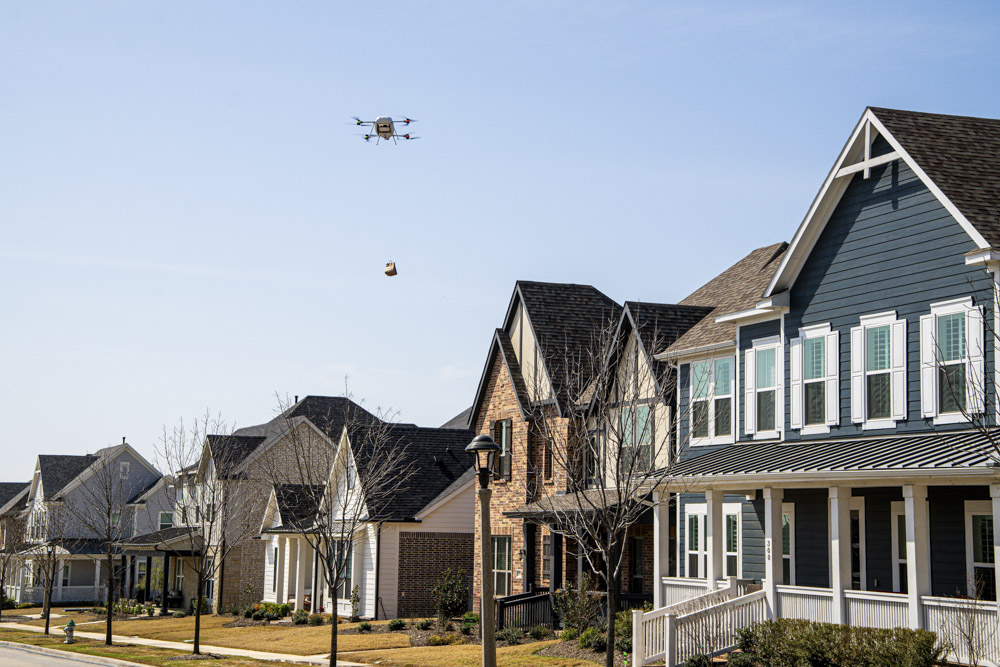
For Manna CEO Bobby Healy, the promise of drone delivery is not the drone.
It’s the neighborhood bookstore that can deliver a purchase across town in minutes. It’s a hospital sending a laboratory sample without putting a driver in traffic. It’s medicine arriving quickly, a defibrillator reaching an emergency, or a local hardware store gaining access to customers it once struggled to serve.
The aircraft eventually should become almost invisible to the customer.
“After 10 or 15 deliveries, they don’t even come out of their houses,” Healy said. “They get the notification, and that’s when they go out to pick up the bag. It’s just like the mailman.”
That’s the future Manna plans to build in Tulsa.
The Ireland-based drone delivery company selected Tulsa for its first full-scale metropolitan U.S. operation and its American manufacturing base. Healy said the decision followed nearly a year of conversations with Oklahoma officials and local organizations about finding a place where Manna could both build its aircraft and operate them across an entire city.
“We wanted two in one,” Healy said. “Wherever we were going to manufacture, we also wanted to be able to fly there with a full citywide implementation.”
Manna designs, manufactures, and operates its aircraft. The company employs about 200 people in Ireland and has conducted commercial drone deliveries for six years.
As it considered locations for its U.S. expansion, Healy said Oklahoma distinguished itself through its willingness to help the company navigate the practical work of entering a new country and establishing an operation.
Tulsa Innovation Labs and the George Kaiser Family Foundation helped Manna identify property, office space, workforce resources, and the local organizations it needed to engage.
“It’s not easy to set up in a new country,” Healy said. “Having someone doing a lot of that heavy lifting for you, or making it easy, is important.”
Healy described the company as looking for “the door widest open.”
Tulsa also offered something more technical: an aerospace workforce and infrastructure intended to support autonomous flight.
Healy pointed to a city-backed radar system known as SAFE-T as a particularly important factor. The system helps detect aircraft that may not be transmitting location information, addressing one of the challenges facing autonomous operators seeking permission to fly beyond the visual line of sight of a human observer.
“If you’re in my shoes, a city that is already investing in infrastructure ahead of the curve—build it and they will come you’ll never get a better example,” Healy said.
The investment, he said, can help clear a path for drone operators to serve a much larger portion of the city.
Manna expects a mature Tulsa network to include about 150 aircraft and reach much of the metropolitan area. Rather than requiring every aircraft to return to the location where it began, the network would allow drones to move between bases positioned across the city.
Healy compared the model to a low-cost airline network.
A drone could leave a bookstore, deliver an order five miles away, and then travel to the nearest Manna base rather than making a full round trip. An aircraft could reposition itself near a hospital before picking up a laboratory sample and carrying it across town.
That network design is what makes lower-volume customers viable, Healy said.
A small independent bookstore may receive relatively few delivery orders, but drone delivery could give it rapid access to hundreds of thousands of potential customers surrounding the business.
“That bookstore now can reach half a million customers with a five-minute flight,” Healy said.
Healy said customers often prefer to purchase from a familiar local business when speed and convenience are comparable to what they receive from a large online retailer.
“The funny thing about drone delivery is it localizes logistics,” he said. “For the first time, it becomes viable because they’re robots and because they’re autonomous.”
Food will remain an important part of the business. Drone delivery is fast enough to keep meals hot and ice cream frozen, and restaurant delivery is familiar to customers.
But Healy pushed back on describing Manna as a food delivery company.
Restaurant demand is concentrated during evenings and weekends. A citywide system becomes more valuable when the aircraft also move parcels, medicine, retail purchases, and medical materials throughout the day.
“Think of us as logistics infrastructure, not food delivery,” Healy said.
That infrastructure will require a substantial Tulsa workforce.
Manna said its expansion could eventually create about 1,000 jobs. Healy expects roughly one-third to involve manufacturing and aircraft maintenance, including technicians, assembly workers, and quality-control employees.
The company will need workers capable of assembling circuit boards, connecting cable harnesses, inspecting aircraft, and maintaining electric propulsion systems.
“It’s kind of the same as building electric cars, except our electric cars fly,” Healy said.

“It’s kind of the same as building electric cars, except our electric cars fly,” Healy said.
Other employees will work in flight operations as remote pilots, base supervisors, and aircraft loaders.
The loaders will receive products from restaurants and retailers, weigh the cargo, inspect the aircraft, and prepare it for flight. Healy said one employee could support 15 to 20 deliveries an hour.
He sees those jobs as a potential next step for people currently working in app-based delivery or other transportation roles.
Unlike many delivery platforms, Manna does not expect to rely on independent gig workers. Healy said the company’s safety and regulatory obligations require employees who receive consistent training and understand its operating procedures.
“We’re essentially an airline,” he said.
Manna also expects to hire software engineers, mechanical engineers, electrical engineers, human resources employees, trainers, recruiters, and other personnel associated with its U.S. headquarters.
Over the next several years, Healy said success will mean more than putting aircraft in the sky.
He wants Tulsa to become a major city for drone technology and for the system to become useful across the community. That could include partnerships with hospitals, laboratories, pharmacies, retailers, emergency services, and local governments.
The challenge will be connecting a fast-moving technology company with institutions that often operate more deliberately.
Integrating drone-delivered defibrillators with emergency dispatch systems, for example, would require participation from public agencies and health care providers.
“Success is not just having the network,” Healy said. “Success is having a network and having the entire community use the network in some way.”
Healy already made a personal commitment to the project. He bought a home in Tulsa and plans to spend considerable time in the city as the company builds its U.S. operation.
Manna came to Tulsa to manufacture aircraft. Its larger ambition is to make those aircraft an ordinary part of how the city moves goods, supports businesses, and responds to urgent needs.
The novelty, Healy believes, will fade quickly.
The five-minute delivery will remain.