
Stitt signs SB 1778, launching sweeping Strong Readers overhaul
The measure expands early screening and interventions and sets a new proficiency pathway aimed at lifting third-grade reading outcomes statewide.
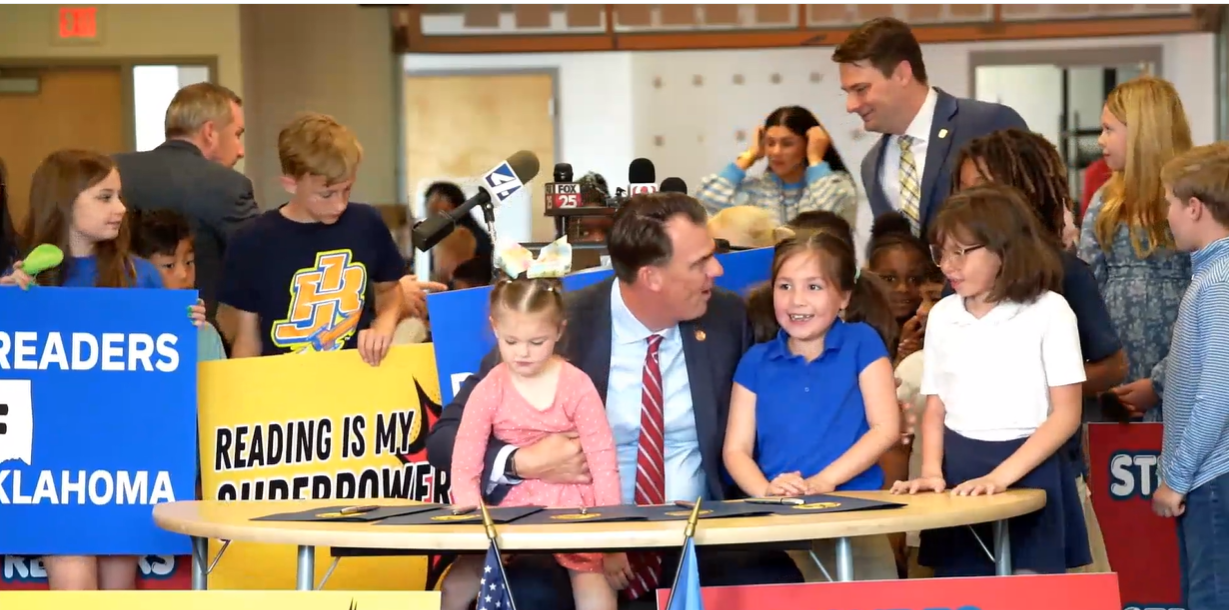
OKLAHOMA CITY (OBV) — Flanked by dozens of children holding blue, yellow and red signs, Oklahoma leaders marked a turning point in the state’s education policy as Senate Bill 1778 was signed into law, enacting the most sweeping rewrite of the Strong Readers Act in more than a decade.
Speaking at the signing, State Superintendent Lindel Fields described the measure as a comprehensive shift in how Oklahoma approaches early literacy.
“This is one of the most significant literacy reforms in the country,” Fields said. “It’s thoughtful, it’s comprehensive, and it reflects a real commitment to getting it right for kids.”
Fields emphasized that while the bill establishes a new framework, success will depend on execution. “The bill gets signed today, but the real work starts tomorrow morning,” Fields said.
The legislation strengthens early screening, expands intervention requirements and formalizes a multi-tiered system of supports designed to identify struggling readers earlier and respond more quickly.
Sen. Adam Pugh, R-Edmond, the bill’s Senate author, framed the moment as the culmination of years of work to raise expectations statewide. “When I first became Chair of Education, I said 100% of our kids should be able to read on level by third grade,” Pugh said. “I was told at the time that was an impossible standard, and I accepted that answer. I shouldn’t have.”
Pugh said SB 1778 pairs higher standards with new investments in classrooms, teachers and science-of-reading instruction so educators have “all the tools necessary to help a child on that journey.”
House Speaker Kyle Hilbert, R-Bristow, who championed the measure in the House, pointed to national comparisons as evidence that Oklahoma can reverse longstanding trends.
“Oklahomans are tired of our state being ranked at or near the bottom of education rankings,” Hilbert said, noting that only 27% of Oklahoma third graders currently read at or above grade level.
Citing Mississippi’s turnaround through early-grade literacy reforms, Hilbert said the bill represents a deliberate decision to “plant our flag in the ground” on early elementary instruction.
Supporters also emphasized the role families play alongside schools.
Both Hilbert and Pugh urged parents and guardians to stay engaged in children’s reading outside the classroom, arguing the law works best when schools and families reinforce one another. “It starts at home,” Hilbert said. “Go home and read to your kids. Read to your grandkids. It’s going to take all of us working together.”
State education officials said implementation will focus on standing up new supports, training educators and aligning systems to deliver results. “We now have a strong framework,” Fields said. “We have the investment. Now it’s about executing with discipline and staying focused on results for kids.”
The signing also drew support from the State Chamber, which has treated strengthening early literacy outcomes as a priority issue under its Oklahoma Competes competitiveness framework. The State Chamber’s playbook lists “education and workforce” and “innovation and entrepreneurship” among the core fundamentals it argues Oklahoma must improve to compete regionally and nationally, and it has explicitly included strengthening the Strong Readers Act as part of its policy agenda.
“The advancement of SB 1778 reflects the real momentum building around literacy across Oklahoma,” State Chamber President and CEO Chad Warmington said. “This policy will strengthen our competitiveness regionally and nationally. When we get early childhood literacy right, everything else gets easier from workforce development to long-term economic growth.”